
Most Bangalore car owners replace their tyres in one of two situations: either they get a flat that cannot be repaired, or someone at a service centre tells them to. Almost nobody replaces tyres proactively — before the tyre has actually become a problem.
That is a significant safety and financial error. A tyre that looks serviceable to the eye can be dangerously compromised in ways that only show up when you need it most — hard braking in a monsoon downpour on Hosur Road, or a sudden swerve to avoid a pothole at 80 km/h on the Mysore Expressway.
At Tyre Torque on Kasturi Nagar Main Road, we inspect thousands of tyres every year. We see the full spectrum — tyres that were replaced too early at a panicked car owner’s insistence and tyres that arrived on cars driven until the wire belt was visible through the rubber. This guide gives you the honest, practical answer to the question we get asked every single day: when should I actually replace my tyres?
The Short Answer: Replace When Any of These 10 Signs Are Present
You do not need to wait for all of them. One is enough.
- Tread depth at or below 3mm (not 1.6mm — see why below)
- Tyre age over 5 years from manufacture date
- Any sidewall bulge or bubble — replace immediately
- Visible sidewall cracking or crazing
- Cord or fabric visible through the tread or sidewall
- Tyre has been driven flat, even for a short distance
- Uneven wear deeper than 2mm difference across the tread face
- Persistent vibration or pulling that returns after balancing
- Repeated slow punctures from the same tyre
- Tyre has suffered a hard impact (pothole or kerb) and shows deformation
We cover each of these in detail below. But first, there is one Bangalore-specific rule that changes the calculation compared to other Indian cities.
The Bangalore Rule: Replace at 3mm, Not 1.6mm
The legal minimum tread depth in India is 1.6mm. If you drive with tread below this, you are driving illegally. But the legal minimum is not the safety minimum — and in Bangalore, the gap between these two figures matters more than in almost any other Indian city.
Here is why: when tread depth drops below 3mm, tyres lose their ability to channel water away from the contact patch, dramatically increasing your risk of hydroplaning — that terrifying moment when your car essentially floats on a thin layer of water and you temporarily lose all steering and braking control. On roads like Hosur Road, ORR near Silk Board, or the underpass at Hebbal during heavy rain, hydroplaning at 60-80 km/h can be catastrophic.
Bangalore receives concentrated, intense monsoon rainfall from June through September. The city’s road network — with its underpasses that flood in under an hour, its flyover approaches that become rivers, and its residential road surfaces that collect standing water for days — makes aquaplaning a real and frequent risk for the four months of peak monsoon.
A tyre with 2mm of tread in dry conditions still stops your car reasonably well. That same tyre in the flooded stretch near Hebbal junction at 7 AM in July is a significantly different proposition.
Our recommendation at Tyre Torque: treat 3mm as your replacement threshold, not 1.6mm. Budget the replacement when you hit 3mm, not when you are already below the legal limit.
How to Check Tread Depth at Home — Three Methods
The 2-rupee coin test: Insert a 2-rupee coin into the tread groove with the denomination facing down. If you can see the “2” clearly without any tread covering it, your depth is below approximately 2.5mm. Replace soon.
The 1-rupee coin test: Insert a 1-rupee coin into the tread groove with the Ashoka emblem facing down. If the entire emblem is visible, you are below 1.6mm — the legal minimum. Replace immediately.
Built-in tread wear indicators: All modern tyres have small raised rubber bars moulded into the base of the tread grooves — typically at 1.6mm depth. When the tread surface is flush with these bars, the tyre has reached its legal minimum. Look across the tread from the side of the car. If the bars are visible and flush with the tread, do not wait another day.
Do this check at five points: Do not test tread depth at just one spot on the tyre. Check the inner edge, outer edge, and three points across the centre tread. Uneven readings — more than 2mm difference between inner and outer edge — indicate alignment problems that need fixing before any new tyre is fitted.
Sign 1: Tread Depth at or Below 3mm
Already covered above. Use the coin test monthly. At 4mm, start planning for replacement. At 3mm, book it. At 1.6mm or below, do not drive to the workshop — call us and we will come to you or send a technician.
Sign 2: Tyre Age Over 5 Years — How to Check Your DOT Date
This is the sign that surprises people most. A tyre with 6mm of remaining tread — looking perfectly serviceable — can be a safety hazard if it is more than five years old.
Most tyre manufacturers recommend replacement after 5-6 years regardless of remaining tread depth. In Bangalore’s climate — with intense sun, high humidity, and significant temperature swings — tyres can degrade even faster.
What happens to old tyres? The rubber compound contains oils and polymers that maintain flexibility and grip. These compounds evaporate slowly over time. As they deplete, the rubber becomes harder and more brittle. Grip decreases — particularly in wet conditions. Micro-cracks develop in the sidewall and between tread blocks, which are often invisible to the naked eye but compromise structural integrity.
Bangalore accelerates this process. Strong UV radiation from March through May, high temperatures in summer, and the heat cycling from stop-start traffic all degrade rubber faster than cooler or less sunny cities.
How to Read the DOT Date on Your Tyre
Every tyre has a DOT (Department of Transportation) code moulded into the sidewall. At the end of this code is a 4-digit number — the manufacturing week and year.
For example: DOT XXXX 2722
The last four digits are what matter. 27 = week 27 (early July). 22 = 2022. This tyre was manufactured in the first week of July 2022. It should be replaced by July 2027 at the latest — regardless of tread depth.
Check all four of your tyres. It is common for cars to have tyres of different ages — perhaps three from one batch and a spare that was fitted when the original tyre was damaged. Knowing your oldest tyre’s age tells you when to budget for replacement.
The 5-year rule in Bangalore: For private passenger cars doing normal mileage (under 25,000 km/year), replace at 5 years from manufacture. For high-mileage cars, fleet vehicles, or cabs doing 50,000+ km/year, replace at 4 years — the combination of high mileage and heat cycling accelerates degradation.
Sign 3: Sidewall Bulge or Bubble — Replace Immediately, No Exceptions
A bulge on the sidewall of your tyre is not something to monitor or delay on. It is a structural failure. Replace the tyre the same day.
What causes a sidewall bulge? The tyre’s internal structure consists of steel belts and cord plies running beneath the rubber surface. When your tyre hits a hard object — a deep pothole on ORR, a sharp kerb in a Koramangala parking bay, an unmarked speed breaker at speed — the impact can sever or separate these internal cords while leaving the outer rubber intact. The result is a bubble where the internal air pressure is no longer contained by the structural cords — only by the outer rubber skin.
That outer rubber skin is the only thing standing between your tyre and a blowout. It will not hold indefinitely. The failure can happen at 15 km/h in a parking lot or at 100 km/h on the NICE Road — the tyre has no way of choosing a convenient moment.
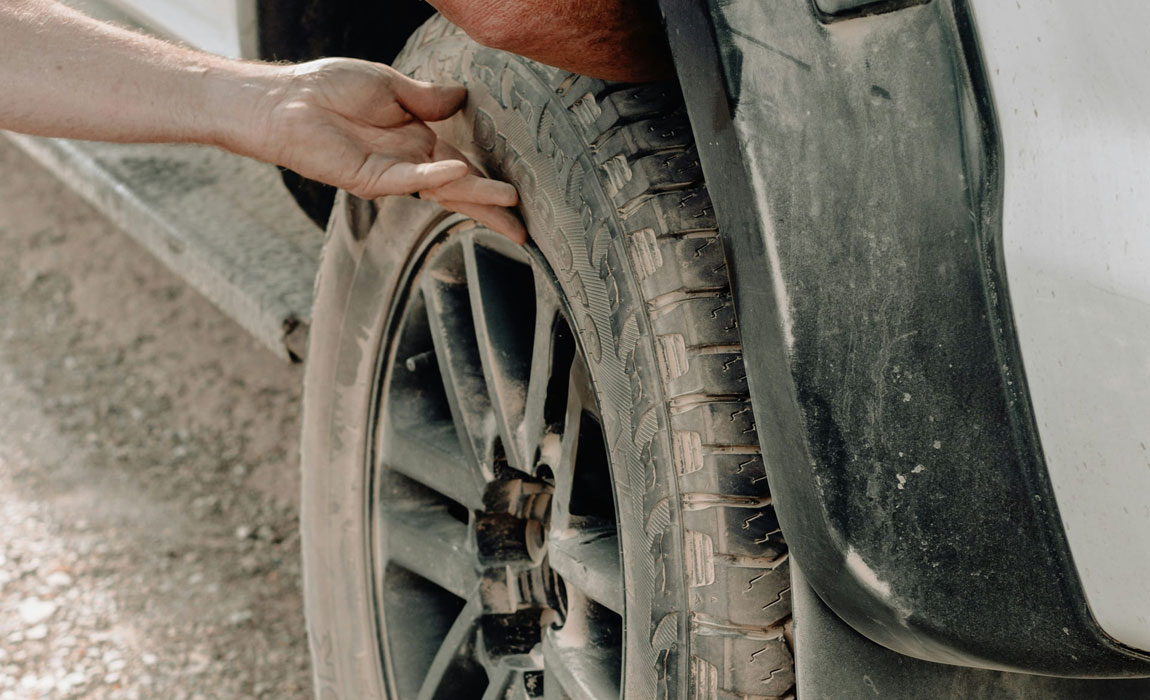
How to spot it: Run your hand slowly around the sidewall and inner sidewall of each tyre when the car is parked. A bulge feels like a localised swelling — often oval or circular, typically 3–6 cm across. On dark tyres in low light it can be hard to see — feel for it rather than looking for it.
If you find a sidewall bulge, do not drive to the workshop. Put on your spare tyre and then drive. Or call Tyre Torque for emergency assistance — we assist with tyre casualties within our service area.
Sign 4: Sidewall Cracking — When It Becomes Dangerous
Fine surface cracks on the sidewall are common on tyres over three years old, particularly on cars parked outdoors in Bangalore’s direct sun. A small amount of surface crazing is normal ageing — not immediately dangerous.
The question is: how deep and how widespread?
Minor surface crazing (hairline cracks, finely networked, no depth) — monitor. Check again in 3 months. If the tyre is over 4 years old and shows this level of crazing, plan replacement at your next service.
Deep or wide cracking (cracks you can see into, or cracks that extend across the sidewall in longer lines) — replace. The structural integrity has been compromised.
Cracking between tread blocks (visible cracks at the base of the tread grooves) — replace immediately. This indicates the compound has hardened and lost elasticity. Wet-road grip is already significantly reduced, and the tyre is at risk of tread separation.
On Bangalore cars specifically, check for cracking between the lower sidewall and the bead — the part that sits against the wheel rim. Bangalore’s frequent monsoon immersion of tyres in standing water, followed by baking in summer sun, creates the worst possible cycle for bead-area cracking.
Sign 5: Cord or Fabric Visible Through Rubber
If you can see the tyre’s internal cord or fabric through the rubber — on the tread surface, sidewall, or anywhere — this is a catastrophic failure state. The tyre is structurally compromised and must be treated as a non-functional tyre. Do not drive on it. Replace immediately.
This level of wear or damage is unfortunately not uncommon on cab and fleet vehicles in Bangalore where tyre replacement schedules are stretched too far.
Sign 6: Driven Flat — Even Once
This is one of the least-known tyre replacement triggers, and it catches many Bangalore car owners off guard.
If your tyre has been driven flat — even for 300–500 metres to reach a safer spot or the nearest tyre shop — the sidewall has been crushed repeatedly against the road surface without the protection of air pressure. This folding damages the internal cord structure even if the outer rubber looks intact after reinflation.
A tyre that has been driven flat may hold air perfectly after being repaired or reinflated. But the internal structure is compromised. We see this at our workshop regularly — a tyre that was driven flat six months ago, looks fine, holds pressure fine, and then fails suddenly on the highway with no warning.
The rule: if it was driven flat for any meaningful distance, replace it. A mushroom puncture repair on a tyre that was driven flat is not a safe repair — the damage extends beyond the puncture hole.
Sign 7: Uneven Wear — What Each Pattern Tells You
Uneven tyre wear is not just a tyre replacement signal — it is a diagnostic signal that tells you what else is wrong with your car. Always fix the underlying cause before fitting new tyres. Otherwise the same wear pattern will develop on the new set.
| Wear Pattern | What It Looks Like | Cause | Fix Before Replacing |
|---|---|---|---|
| Inner edge wear | Inner side of tyre worn faster | Negative camber, overloaded rear axle | Wheel alignment |
| Outer edge wear | Outer side of tyre worn faster | Positive camber, under-inflation | Alignment + tyre pressure |
| Centre wear | Centre of tread worn faster | Chronic over-inflation | Correct tyre pressure |
| Edge wear both sides | Both edges worn, centre fine | Chronic under-inflation | Correct tyre pressure |
| Patchy / cupped wear | Scalloped or diagonal wear pattern | Worn shock absorbers, unbalanced wheels | Suspension check + balancing |
| One-sided wear on front only | One front tyre edge worn significantly more | Toe misalignment | Immediate alignment |
Patchy or cupped wear — where the tread surface shows peaks and troughs across its width — is the pattern we see most commonly on Bangalore cars. Bangalore’s pothole-heavy roads accelerate shock absorber wear, and worn shocks cause the tyre to bounce and skip rather than rolling smoothly. Each skip scrapes a small amount of rubber off the tread, creating the cupped pattern. New tyres on worn shocks will develop the same pattern within 10,000 km.
Sign 8: Vibration That Returns After Balancing
Steering wheel vibration — particularly at speeds between 60 and 100 km/h — has two common causes: unbalanced wheels and deformed tyres.
Wheel balancing corrects weight distribution imbalance. If the vibration disappears after balancing but returns within 2,000–4,000 km, the tyre itself has internal deformation — typically from repeated hard pothole impacts. The tyre is no longer uniformly round, and balancing weights cannot correct a non-round tyre.
In Bangalore, where potholes on ORR and Marathahalli Bridge deliver repeated hard impacts to the same tyres, this type of internal deformation is common. If vibration returns consistently after balancing, replacement is the correct solution — not repeated balancing.
Sign 9: Repeated Slow Punctures From the Same Tyre
A single slow puncture is usually a nail or valve fault. Two or three slow punctures from the same tyre within a few months indicates one of three things: the tyre bead is not seating properly on the rim (often from a pothole-bent rim), the tyre has a hairline crack near the bead area, or the valve stem is damaged.
If a tyre keeps losing pressure despite multiple puncture repairs or valve replacements, bring the tyre off the car to a quality workshop. A water submersion test will reveal whether there is a bead-area crack or ongoing seating issue. If the bead area is cracked, the tyre must be replaced — bead cracks cannot be repaired.
Sign 10: Hard Impact Damage — The Post-Pothole Check
This is the most actionable sign for Bangalore car owners specifically. After any hard pothole impact — the kind that makes a loud thud and jolts the whole car — carry out this three-point check before your next long journey:
Check 1: Park on flat ground and visually inspect all four sidewalls for bulging. Run your hand around each sidewall. Even if nothing is visible, feel for deformation.
Check 2: Check tyre pressure on all four tyres within 30 minutes of the impact. A pressure drop in the impacted tyre indicates the seal has been compromised.
Check 3: Drive slowly in a straight line and feel for pulling to one side or new vibration. Either indicates alignment disruption or tyre deformation from the impact.
If any of these three checks reveals a problem, come in immediately. If all three are clear but the impact was severe, still bring the car for an alignment check within 500 km — hard pothole impacts routinely knock Bangalore cars significantly out of alignment even without visible tyre damage.
The Cost of Waiting — In Real Rupees
The financial argument for proactive tyre replacement is often stronger than the safety argument for people who are confident in their own driving ability. Here is what delayed replacement actually costs:
Worn tyres destroy your wheel alignment repair. If you get a wheel alignment done on a car with 2mm tread depth, the worn tyres will continue scrubbing sideways and negate part of the alignment benefit. You will need alignment again sooner, adding ₹1,000–₹1,500 to your recurring costs.
Worn tyres on a misaligned car destroy new tyres fast. The most expensive sequence of events we see: customer fits new tyres without fixing the alignment that destroyed the old ones. The new tyres show significant edge wear within 15,000 km. On a ₹28,000 four-tyre fitment, that is thousands of rupees of tyre life lost before the first service is due.
A blowout costs far more than a tyre. A tyre failure at highway speed on the Mysore Expressway or NICE Road typically results in one or more of: damaged alloy wheel (₹5,000–₹15,000 repair or replacement), damaged suspension component from the impact of the flat section hitting the road, damage to the second tyre on the same axle, and emergency recovery costs. A proactive ₹6,000 tyre replacement looks very cheap against an ₹18,000–₹40,000 blowout bill.
The Bangalore Monsoon Rule — Your Annual Tyre Calendar
Use this simple annual calendar for tyre inspection in Bangalore:
April–May (pre-monsoon): This is the single most important tyre inspection of the year. Inspect all four tyres for tread depth, age, and sidewall condition before the rains arrive. If any tyre is approaching 3mm or close to 5 years of age, replace it now — before the monsoon, not during it. Replacing tyres in June during peak monsoon season means driving on worn rubber through the most dangerous road conditions of the year.
October (post-monsoon): The second mandatory inspection. Six months of monsoon road conditions — flooded roads, pothole impacts from craters that opened up overnight, UV stress during intermittent dry spells — will have accelerated wear and ageing. Check tread depth again. Check sidewalls for new cracking. Check for wear pattern changes that signal alignment drift.
January: A light check before the year gets busy. Bangalore’s December–January road repair season changes road profiles and introduces fresh speed breakers. If you notice any new pulling or vibration after a road is repaired or a new speed breaker appears on your commute route, check alignment and tyre condition.
Book Your Free Tyre Inspection at Tyre Torque
You do not need to guess whether your tyres need replacing. Come to Tyre Torque on Kasturi Nagar Main Road for a free tyre inspection — we check tread depth at five points across each tyre, measure sidewall condition, check the DOT manufacture date, inspect for bulging and cracking, identify wear pattern irregularities, and give you an honest recommendation.
If you need tyres, we will tell you. If you do not, we will tell you that too — with the measurements to prove it. We do not upsell services that are not needed.
We stock the complete range for every car — MRF, CEAT, Apollo, JK Tyre, Goodyear, Yokohama, Bridgestone, Continental, Pirelli, and Michelin — fully fitted, balanced with nitrogen, and aligned at our Kasturi Nagar workshop.
Tyre Torque — NV Tyre Centre
📍 Kasturi Nagar Main Road, Near CMR College, Next to Nayara Petrol Station, Chikka Banaswadi, Bangalore — 560043
📞 Call / WhatsApp: +91-72041-01993
⏰ Monday to Sunday, 9 AM – 8 PM
🌐 www.tyretorque.in
✅ Free tyre inspection on every visit | Free nitrogen top-up for life | All major brands in stock
Frequently Asked Questions — When to Replace Tyres in Bangalore
How do I know if my car tyres need replacing in Bangalore?
The clearest signs are tread depth at or below 3mm (use the 2-rupee coin test), tyre age over 5 years from the manufacture date on the sidewall, any sidewall bulge or bubble, visible cord through the rubber, cracking in the sidewall or between tread blocks, and persistent vibration after wheel balancing. In Bangalore, the 3mm threshold is more important than the legal 1.6mm minimum because of the city’s monsoon rainfall and aquaplaning risk.
How do I check the age of my car tyres?
Look for the DOT code moulded into your tyre’s sidewall. At the end of this code is a 4-digit number — the first two digits are the week of manufacture and the last two are the year. For example, “1922” means the tyre was made in week 19 of 2022 (early May 2022). Count 5 years from that date for your replacement deadline. Check all four tyres separately — they may have been fitted at different times and have different manufacture dates.
Can a tyre with a bulge be repaired instead of replaced?
No. A sidewall bulge indicates that the internal cord structure has been severed or separated, usually from a hard pothole impact. This structural damage cannot be repaired — there is no patch or plug that can restore the internal integrity of the tyre. A bulged tyre is a blowout waiting to happen and must be replaced immediately, regardless of remaining tread depth.
Is it safe to drive on tyres with cracks in the sidewall in Bangalore?
Minor surface crazing on tyres over 3 years old is normal and not immediately dangerous. However, deep or wide cracks — ones you can see into, or that run in longer lines across the sidewall — indicate structural weakening and should be replaced promptly. Cracks between tread blocks are particularly serious as they indicate the compound has hardened and lost elasticity, reducing wet-road grip significantly. Given Bangalore’s monsoon conditions, cracked sidewalls should not be left unaddressed beyond the next service interval.
How often should I check my tyres in Bangalore?
A full tyre inspection — tread depth, sidewall condition, wear pattern, pressure — should be done every 3 months at minimum in Bangalore, and after any hard pothole impact. Tyre pressure should be checked every two weeks because Bangalore’s stop-start traffic causes pressure to fluctuate more than steady highway driving. The two most important annual inspection points for Bangalore car owners are April–May before the monsoon and October after the monsoon ends.
The Bottom Line
The simple version: in Bangalore, check your tyres every three months. Replace at 3mm tread depth, not 1.6mm. Replace at 5 years regardless of tread. Never delay on a sidewall bulge. Book a pre-monsoon inspection every April or May before the rains arrive — that single habit will prevent the majority of tyre-related incidents that Bangalore car owners experience.
When in doubt, come in. The inspection is free and takes 15 minutes.

3 Responses