
That ₹100 Repair Cost You ₹12,000 — Here’s How
It’s Tuesday evening. You’re driving home from office. You notice your front-left tyre going flat near Silk Board junction. You pull into the nearest tyre shop.
“Small puncture sir. ₹100.”
Ten minutes later you’re back on the road. Problem solved. Or so you think.
Three weeks later — same tyre. Going flat again.
You visit a different shop. “Sir, someone has done a plug repair. Not permanent. Let me redo it. ₹150.”
Two weeks after that — going flat again. A third shop now tells you: “Sir, inner liner is damaged from driving on low pressure. Tyre needs replacement. ₹8,500.”
Total cost of that ₹100 “repair”: ₹8,750. Plus three shop visits. Plus the stress.
This happens to hundreds of Indian drivers every single day. Not because punctures are unavoidable — but because most drivers don’t know the difference between the three types of puncture repair, and which one actually works.
This complete guide explains all three methods, exact costs across India, when each is appropriate, and why choosing the cheapest option almost always costs the most in the long run.
India’s Puncture Problem: The Numbers
Before diving into repair types, understand how big this problem is:
- India has 30+ crore registered vehicles (2026)
- Average Indian car gets 3-4 punctures per year
- ₹150 crore spent annually on puncture repairs in India
- 60% of repairs are external plugs (most fail within 3 months)
- Only 15% of Indian tyre shops offer mushroom repairs (the only permanent fix)
- 4 out of 10 tyre replacements happen because of failed repairs damaging the inner liner
The painful reality: Most Indians pay 3-5 times more for puncture repairs than necessary — not because repairs are expensive, but because cheap repairs keep failing and eventually destroy the tyre entirely.
The 3 Types of Puncture Repair: Side-by-Side Overview
| Feature | External Plug | Internal Patch | Mushroom Repair |
|---|---|---|---|
| Cost India | ₹80-200 | ₹200-400 | ₹250-450 |
| Tyre removed from rim? | ❌ No | ✅ Yes | ✅ Yes |
| Inner liner sealed? | ❌ No | ✅ Yes | ✅ Yes |
| Puncture hole sealed? | ✅ Partially | ❌ No | ✅ Yes |
| Repair time | 10-15 min | 25-35 min | 40-55 min |
| Lifespan | 2-8 weeks | 6-12 months | Full tyre life |
| Success rate | 30-40% | 60-70% | 95-98% |
| Safe for highways? | ❌ No | ⚠️ Sometimes | ✅ Yes |
| Safe for 80+ kmph? | ❌ No | ⚠️ Sometimes | ✅ Yes |
| Monsoon-proof? | ❌ No | ⚠️ Partially | ✅ Yes |
| Permanent fix? | ❌ No | ❌ No | ✅ Yes |
METHOD 1: External Plug (String/Rope Plug)
What It Is
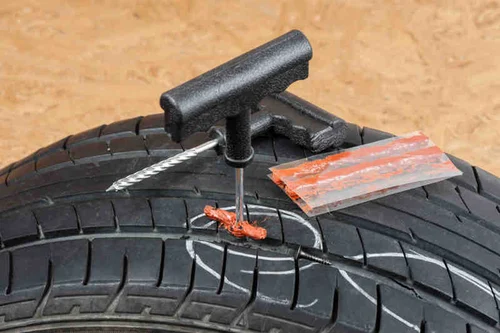
The external plug — also called rope plug, string plug, or worm plug — is the most common puncture repair in India. It involves inserting a rubber string coated with adhesive through the puncture hole from the outside of the tyre, without removing the tyre from the rim.
Walk into any roadside tyre shop, petrol pump vulcaniser, or highway dhaba tyre repair — this is what they do.
The Process (10-15 minutes)
- Locate puncture hole (water spray, find bubbles)
- Ream hole with spiral tool (enlarges it slightly)
- Thread rubber string through needle tool
- Push needle + string through hole from outside
- Pull needle back out (string stays in hole)
- Trim excess flush with tread
- Inflate and check for leaks
Current Costs Across India (2026)
| City/Location | Roadside Shop | Petrol Pump | Tyre Shop |
|---|---|---|---|
| Delhi/NCR | ₹80-120 | ₹100-150 | ₹120-180 |
| Mumbai | ₹100-150 | ₹120-180 | ₹150-200 |
| Bangalore | ₹100-150 | ₹120-180 | ₹150-200 |
| Chennai | ₹80-130 | ₹100-150 | ₹130-180 |
| Hyderabad | ₹80-130 | ₹100-160 | ₹130-190 |
| Pune | ₹100-150 | ₹120-170 | ₹150-200 |
| Kolkata | ₹80-120 | ₹100-140 | ₹120-160 |
| Highway dhaba | ₹150-250 | N/A | N/A |
| Remote area | ₹200-400 | N/A | N/A |
Why External Plugs Fail in India
Indian road and climate conditions are uniquely harsh on external plugs:
Heat Degradation:
- Delhi summer: 44°C ambient, 70°C+ road surface
- Bangalore summer: 38°C ambient, 65°C road surface
- Rubber plug softens → loses grip → falls out
- Timeline: 3-6 weeks in summer
Monsoon Penetration:
- India has 4-6 months monsoon in most regions
- Water seeps between plug and tyre rubber
- Weakens adhesive bond
- Inner liner gets exposed to moisture → corrosion
Pothole Impact:
- India has 5+ lakh potholes officially (actual number 10x)
- Each pothole impact = mechanical force on plug
- 300-500 pothole hits/month on average Indian road
- Plug gradually loosens → leak restarts
Highway Speeds:
- Tyre flexes 11 times per second at 100 kmph
- Each flex: Plug hole opens/closes
- 660 flex cycles per minute = material fatigue
- Plug loses elasticity → permanent leak develops
The Physics Problem: External plug is held by friction only. Constant 32 PSI internal pressure (8.9 pounds on a 6mm puncture hole) pushes outward 24/7. Pothole impacts + heat cycling + moisture = the plug works loose in weeks, not months.
When External Plug is Acceptable
Despite limitations, plug repairs have legitimate use cases:
✅ Emergency roadside repair (need to reach nearest tyre shop)
✅ Tyre near end of life (<3mm tread, 1-2 months remaining)
✅ Very old tyre (not worth ₹400 mushroom repair)
✅ Temporary fix (explicit understanding it needs proper repair within a week)
✅ Remote location (mushroom repair not available, need to reach city)
When Never to Use External Plug
❌ New or expensive tyres (Michelin, Bridgestone, Continental)
❌ Highway driving (NH48, ORR, expressways)
❌ Monsoon season (rain + plug = guaranteed failure)
❌ Speeds above 80 kmph (structurally unsafe)
❌ As a permanent repair (it’s not one, regardless of what the shop says)
METHOD 2: Internal Patch
What It Is
Internal patch repair requires removing the tyre from the rim completely, inspecting the inner liner, cleaning and buffing the area around the puncture, and bonding a rubber patch to the inner liner using vulcanising cement.
This was the standard repair method before mushroom repairs became widely available.
The Process (25-35 minutes)
- Remove tyre from rim completely
- Inspect inner liner for damage
- Identify puncture location from inside
- Buff area around puncture (120mm diameter)
- Clean with surface cleaner (removes oil/debris)
- Apply vulcanising cement to buffed area
- Apply cement to patch backing
- Wait 5-7 minutes (cement must dry — most critical step)
- Press patch firmly onto inner liner
- Roll with stitcher tool (removes air bubbles, ensures bond)
- Remount, inflate, water test
Current Costs Across India (2026)
| City | Standard Shop | Premium Shop | Authorised Dealer |
|---|---|---|---|
| Delhi/NCR | ₹180-280 | ₹280-380 | ₹400-600 |
| Mumbai | ₹200-300 | ₹300-400 | ₹450-650 |
| Bangalore | ₹200-300 | ₹300-400 | ₹400-600 |
| Chennai | ₹180-280 | ₹280-380 | ₹400-550 |
| Hyderabad | ₹180-280 | ₹280-380 | ₹400-550 |
| Tier 2 Cities | ₹150-250 | ₹250-350 | ₹350-500 |
| Tier 3 Cities | ₹120-200 | ₹200-300 | ₹300-450 |
Why Patch-Only Has Limitations
Despite being better than external plug, patch-only repair has a structural weakness:
The Problem: Patch seals the inner liner (stops air from escaping inward) but does NOT seal the puncture hole through the tread. The hole remains open.
What Happens:
- Water enters puncture hole from outside
- Travels through tread layers
- Reaches inner liner
- Moisture trapped between tread and liner = delamination risk
- Patch bond weakens over time
- After 6-12 months: Patch lifts, leak restarts
India-Specific Issue: Road debris (stones, gravel, grit) enters the open puncture hole. Works deeper into tread structure. Gradually compromises the repair. More pronounced on India’s dusty, gritty roads.
When Patch Is Appropriate
✅ Inner liner damage (no hole through tread, just liner scratch)
✅ Large tread area damage (needs liner reinforcement)
✅ Complement to mushroom (extra liner reinforcement on large holes)
✅ Better option than plug (when mushroom not available and need lasting repair)
METHOD 3: Mushroom Puncture Repair (The Only Permanent Fix)
What It Is
Mushroom repair (also called combination repair, plug-patch repair, or uni-seal repair) combines both repair methods in one unit. The repair looks like a mushroom: a rubber stem (plug) goes through the puncture hole, and a rubber cap (patch) bonds to the inner liner.
It’s the only repair method recommended by tyre manufacturers (Michelin, Bridgestone, Continental, Goodyear, Apollo, CEAT — all specify mushroom/combination repair as the correct method).
The Process (40-55 minutes)
Step 1: Remove & Inspect (10 min)
- Remove tyre from rim completely
- Inspect entire inner liner under bright light
- Check for hidden damage from driving on low pressure
- Verify puncture is in repairable zone (center 75% of tread)
- Measure puncture size (must be under 6mm for standard mushroom)
Step 2: Surface Preparation (10 min)
- Mark puncture location on inner liner
- Ream puncture hole from inside (clean circular hole)
- Buff 120mm diameter area on inner liner
- Wire brush creates rough texture (increases bonding surface)
- Clean with solvent (removes oils, rubber dust)
- Let dry completely (moisture kills cement bond)
Step 3: Cement Application (8 min)
- Apply thin, even coat of vulcanising cement to buffed area
- Apply cement to mushroom patch base (cap side)
- Time both coats — must air-dry 5-7 minutes exactly
- Check cement: Should feel tacky (slightly sticky), not wet
- This step is where most shops fail (rush it = repair fails)
Step 4: Mushroom Installation (7 min)
- Insert mushroom stem through puncture from inside
- Pull stem through with locking pliers from outside
- Pull firmly — mushroom cap must sit completely flat on liner
- Centre cap precisely over puncture
- Roll cap with stitcher tool, centre outward (removes air)
- Apply 15+ PSI rolling pressure (critical for bonding)
Step 5: Finishing (5 min)
- Trim excess stem flush with tread surface
- Buff trim area smooth (prevents road debris snagging)
- Apply finish cement over stem (optional but recommended)
Step 6: Verification (10 min)
- Remount tyre on rim
- Inflate to correct pressure
- Submerge in water tank (check for any leaks)
- Confirm zero bubbles (indicates complete seal)
- Rebalance wheel (weights may have been disturbed)
Step 7: Quality Check (5 min)
- Torque wheels correctly
- Test drive (short run)
- Verify pressure stable after 5 minutes running
- Issue warranty (standard: 6-12 months)
Current Costs Across India (2026)
| City/Type | Budget Shop | Standard Shop | Premium Shop | Authorised Dealer |
|---|---|---|---|---|
| Delhi/NCR | ₹250-300 | ₹300-400 | ₹400-500 | ₹500-700 |
| Mumbai | ₹280-350 | ₹350-450 | ₹450-600 | ₹600-800 |
| Bangalore | ₹280-350 | ₹350-450 | ₹450-600 | ₹600-800 |
| Chennai | ₹250-320 | ₹300-400 | ₹400-550 | ₹500-700 |
| Hyderabad | ₹250-330 | ₹300-400 | ₹400-550 | ₹500-700 |
| Pune | ₹280-350 | ₹350-450 | ₹450-580 | ₹550-750 |
| Kolkata | ₹220-300 | ₹280-380 | ₹380-500 | ₹480-650 |
| Ahmedabad | ₹220-300 | ₹280-370 | ₹380-500 | ₹480-650 |
| Tier 2 Cities | ₹200-280 | ₹260-360 | ₹350-480 | ₹450-600 |
| Tier 3 Cities | ₹180-250 | ₹230-320 | ₹300-420 | ₹400-550 |
Why Mushroom Repair is Permanent
Dual Seal (Inside + Outside):
- Cap seals inner liner (stops air escaping inward)
- Stem fills puncture hole completely (stops water entering outward)
- Together: Complete hermetic seal
Pressure Strengthens the Repair:
- Unlike external plug (pressure pushes it OUT)
- Mushroom cap: Tyre pressure pushes cap HARDER against liner
- Higher the pressure → better the seal
- ORR speeds increase pressure → better, not worse
Chemical + Mechanical Bond:
- Vulcanising cement creates chemical fusion (not just sticky)
- Rubber-to-rubber vulcanisation = as strong as original tyre
- Stitching tool creates mechanical interlocking
- Combined: Repair area becomes STRONGER than surrounding tyre
Monsoon-Proof:
- Stem fills hole: Water can’t enter tread
- Cap sealed to liner: Water can’t enter from inside
- Vulcanised bond: Water-resistant
Highway-Safe:
- Tested to: 180+ kmph (exceeds India’s highest speed limit)
- Approved by: All major tyre manufacturers
- Used by: Commercial trucks, race track support vehicles, emergency services
The Real Cost Comparison (10-Year Analysis)
Scenario: Honda City Tyre (₹9,200 per tyre)
Location: Bangalore, Annual Distance: 18,000 km
Option A: External Plug (₹150 per repair)
| Timeline | Event | Cost | Running Total |
|---|---|---|---|
| Month 0 | Nail puncture, plug repair | ₹150 | ₹150 |
| Month 1.5 | Plug failed, re-plugged | ₹150 | ₹300 |
| Month 3 | Failed again, different shop | ₹180 | ₹480 |
| Month 4 | Inner liner damaged from low-pressure driving | — | ₹480 |
| Month 4 | Tyre cannot be repaired, replacement needed | ₹9,200 | ₹9,680 |
Additional Hidden Costs:
- 4 shop visits × 1 hour = 4 hours wasted
- Petrol pump fills (weekly) = ₹200 over 3 months
- Fuel efficiency loss (under-inflated) = ₹600 over 3 months
- Stress and anxiety: Priceless
Total Real Cost: ₹10,480
Option B: Patch-Only (₹280 per repair)
| Timeline | Event | Cost | Running Total |
|---|---|---|---|
| Month 0 | Nail puncture, patch repair | ₹280 | ₹280 |
| Month 8 | Patch lifted (monsoon moisture), re-patched | ₹280 | ₹560 |
| Month 16 | Failed again, inner liner delamination | — | ₹560 |
| Month 16 | Tyre needs replacement | ₹9,200 | ₹9,760 |
Total Real Cost: ₹9,760
Option C: Mushroom Repair (₹380 per repair)
| Timeline | Event | Cost | Running Total |
|---|---|---|---|
| Month 0 | Nail puncture, mushroom repair | ₹380 | ₹380 |
| Month 1-60 | Zero issues, tyre runs full lifespan | ₹0 | ₹380 |
| Month 48 | Tyre reaches natural end of life (60,000 km) | ₹9,200 | ₹9,580 |
Total Real Cost: ₹9,580
Mushroom repair actually COSTS LESS TOTAL than cheaper alternatives.
Real Savings vs External Plug: ₹900
Real Savings vs Patch: ₹180
Peace of Mind: Priceless
How to Verify Your Shop Did It Correctly
For External Plug (If You Must Use It):
Acceptable: ✅ Shop used rubber string plug (not foam or sealant) ✅ Checked for leaks after repair ✅ Told you it’s temporary
Walk Away If: ❌ Used aerosol sealant (“tyre puncture fix” cans) ❌ Claimed it’s permanent ❌ Didn’t check for leaks after repair
For Patch Repair:
Signs It Was Done Correctly: ✅ Tyre was removed from rim (mandatory) ✅ Can see buff marks on inner liner (rough surface) ✅ Patch is smooth with no edges lifting ✅ Rolled with stitcher (no air bubbles under patch) ✅ Water tested after remounting
Signs It Was Done Wrong: ❌ Tyre wasn’t removed (can’t do proper patch externally) ❌ Patch applied wet (cement not dried properly) ❌ Edges lifting (poor bonding) ❌ Rushed (under 20 minutes total)
For Mushroom Repair:
Signs It Was Done Correctly: ✅ Tyre definitely removed from rim (45+ minutes total) ✅ Can see stem through tread (trimmed flush) ✅ Inner cap visible if you look inside (smooth, bonded flat) ✅ Water tested — zero bubbles confirmed ✅ Warranty card/receipt provided ✅ Felt shop waited for cement to dry (5-7 min pause)
Signs of Fake Mushroom Repair: ❌ Done in under 30 minutes (impossible to do correctly) ❌ Stem sticks out above tread (not trimmed) ❌ Cap has edges not bonded flat (poor stitching) ❌ No water test done ❌ “We did mushroom repair” but tyre never left rim (impossible)
Puncture Types: Which Repair Works for Each?
Type 1: Nail/Screw in Tread Center (Most Common)
Description: Standard nail or screw embedded in center 75% of tread
Diameter: Usually 3-8mm
Best Repair: Mushroom ✅
Can Use Plug: Temporarily only
Success Rate: 98% with mushroom
Type 2: Tyre Bead/Sidewall Puncture
Description: Puncture on the side of tyre (not tread)
Location: Below tread shoulder on sidewall
Best Repair: ❌ Not repairable — replace tyre
Why: Sidewall flexes constantly (350+ RPM at speed). No repair holds.
Risk: Any repair attempt can cause catastrophic blowout.
Action: Replace tyre immediately. Do not drive on it.
Type 3: Tyre Shoulder Puncture
Description: Puncture near edge of tread (outer 25%)
Location: Transition between tread and sidewall
Best Repair: ⚠️ Borderline — assess carefully
Why Difficult: High flex zone. Even mushroom repair under stress.
Recommendation: Replace if possible. Short-term mushroom repair if budget constrained, with caution on highways.
Type 4: Multiple Punctures
Description: 2+ holes in same tyre
Best Repair: Replace tyre if holes within 30cm of each other
Why: Multiple repairs in proximity weaken structure
Exception: Mushroom repairs can be done if holes are far apart (30cm+)
Type 5: Large Hole (>10mm)
Description: Blowout, large debris, or ripped hole
Size: Larger than 10mm diameter
Best Repair: ❌ Replace tyre
Why: Too large for any standard repair kit. Structural integrity compromised.
Type 6: Slow Leak from Valve Stem
Description: Valve stem cracked, loose, or corroded
Symptoms: Slow pressure loss (1-2 PSI/week), no visible puncture
Best Repair: Replace valve stem (₹40-80)
Time: 10 minutes
Why: Often mistaken for puncture. Check valve first before assuming tyre issue.
City-Specific Puncture Patterns in India
Bangalore:
Most Common Cause: Construction nails (Whitefield, Marathahalli, HSR)
Worst Zones: Silk Board junction, KR Puram underpass, ORR construction stretches
Peak Season: April-May (pre-monsoon construction), October (post-monsoon road work)
Average Annual Punctures per Car: 4-5 (above national average of 3-4)
Why Higher: Continuous infrastructure construction = constant nail debris
Delhi/NCR:
Most Common Cause: Construction + heavy truck debris
Worst Zones: NH48, Gurugram-Delhi stretch, Noida expressway
Peak Season: Summer (road surface breaks, debris increases)
Average Annual Punctures: 4-5
Mumbai:
Most Common Cause: Potholes (impact damage) + monsoon debris
Worst Zones: Western Express Highway, Eastern Freeway, Link Roads
Peak Season: Monsoon (June-September)
Average Annual Punctures: 3-4
Chennai:
Most Common Cause: Coastal salt + construction
Worst Zones: OMR (Old Mahabalipuram Road), ECR
Peak Season: Monsoon (October-December NE monsoon)
Average Annual Punctures: 3-4
5 Questions to Ask Your Tyre Shop
Before handing over your car, ask these:
Question 1: “Will you remove the tyre from the rim?”
Right Answer: “Yes sir, we need to for proper repair”
Wrong Answer: “Not needed, we can fix from outside”
→ If they say no: They’re doing plug only. Walk away for anything permanent.
Question 2: “How long will the repair take?”
Right Answer: “45-55 minutes for mushroom repair”
Wrong Answer: “20 minutes only”
→ Anything under 30 minutes cannot be a proper mushroom repair.
Question 3: “Will you do a water test after repair?”
Right Answer: “Yes, we always test in water bath”
Wrong Answer: “Not necessary, we’re confident”
→ No water test = no quality verification. Not acceptable.
Question 4: “What warranty do you give?”
Right Answer: “6 months / 10,000 km warranty on mushroom repair”
Wrong Answer: “No warranty, puncture repair is done only”
→ No warranty = no confidence in their own work.
Question 5: “Can I watch the repair process?”
Right Answer: “Of course, sir, we’re transparent”
Wrong Answer: “Better you wait outside”
→ If they won’t let you watch: Something to hide. Leave immediately.
When NOT to Repair (Replace Instead)
Immediate Replacement Required:
❌ Sidewall puncture (any size, any location on sidewall)
❌ Hole larger than 10mm (structural compromise)
❌ Shoulder puncture + highway driving planned (safety risk)
❌ Inner liner visibly damaged (delamination visible)
❌ Tyre already had 2+ previous repairs (multiple weak points)
❌ Tyre age 6+ years (rubber degraded, repair won’t hold)
❌ Tread depth below 1.6mm (legally minimum, practically replace at 3mm)
❌ Bulge near puncture (internal structure already failed)
Repair is Cost-Effective:
✅ Center tread puncture, 3-8mm (classic nail/screw)
✅ Tyre less than 5 years old
✅ Tread depth above 3mm
✅ No previous repairs in same area
✅ No visible internal damage
Tyre Sealants: The Hidden Danger
What They Are:
Aerosol tyre sealants (Fix-a-Flat, Turtle Wax Tyre Repair, etc.) inject foam/liquid into tyre to temporarily seal puncture from inside.
Why They’re Dangerous:
For Tyre Shops:
- Sealant coats entire inner liner
- Destroys TPMS sensors (₹3,000+ each to replace)
- Makes proper mushroom repair impossible (contaminated surface)
- Forces tyre replacement even for repairable punctures
For You:
- False sense of security (not structural repair)
- Fails above 60 kmph (centrifugal force distributes sealant)
- Creates imbalance (uneven weight distribution)
- Makes tyre irreparable (wasted ₹8,000-15,000 tyre)
Never use tyre sealant spray unless:
- Genuine emergency (nearest help 100+ km)
- You plan to drive under 40 kmph
- You’ll replace the tyre within 24 hours
Shops that offer sealant repair charge ₹300-500 for “fixing” your puncture while actually making it unrepairable. Classic false economy.
TyreTorque: Professional Puncture Repair Bangalore
Our Mushroom Repair Process:
What We Charge: ₹350 (all-inclusive)
What That Includes: ✅ Complete interior tyre inspection
✅ Professional mushroom repair (45-55 minutes)
✅ Water bath leak test (zero-tolerance verification)
✅ Nitrogen refill after repair
✅ Wheel rebalancing (if weights disturbed)
✅ 6-month / 10,000 km warranty
✅ 48-hour free recheck offer
✅ FREE emergency recheck if pressure loss noticed
Our Standards:
- Genuine cement drying time always observed (7 minutes)
- All 5 quality checks completed before handover
- Never do external plug and call it mushroom
- Show you the inside of repaired tyre (transparency)
- Water test every single repair (non-negotiable)
Emergency Mobile Service:
Coverage: 2km radius from Kasturi Nagar shop
For:
- Sidewall damage (unsafe to drive, need assessment)
- Rapid deflation (can’t reach shop safely)
- Night-time emergency
Call: +91-72041-01993
Response Time: 15-30 minutes
Cost: FREE for existing customers
Pricing Summary:
| Repair Type | TyreTorque Price | Market Range | Warranty |
|---|---|---|---|
| Mushroom Repair | ₹350 | ₹280-500 | 6 months |
| Valve Replacement | ₹80 | ₹40-150 | N/A |
| Internal Patch | ₹280 | ₹200-400 | 3 months |
| External Plug (emergency only) | ₹150 | ₹100-200 | None |
Your Action Plan: What to Do Right Now
If You Have a Nail in Your Tyre NOW:
Step 1: Don’t remove the nail (it may be plugging the hole)
Step 2: Check if tyre is losing pressure (5-minute test)
Step 3: If holding: Drive directly to tyre shop (under 40 kmph)
Step 4: Ask for mushroom repair (not plug)
Step 5: Watch the repair process
Step 6: Verify water test done before paying
If You’ve Had Multiple Failed Plug Repairs:
Step 1: Visit professional tyre shop immediately
Step 2: Ask for full inner liner inspection
Step 3: If inner liner undamaged: Mushroom repair (₹350)
Step 4: If inner liner damaged: Replace tyre (₹8,000-12,000)
Step 5: Learn from this: Always ask for mushroom repair first time
If Your “Repaired” Tyre is Losing Pressure Again:
Step 1: Check repair site (stem still there?)
Step 2: Check valve stem (separate issue?)
Step 3: Visit shop within 24 hours
Step 4: If repair failed within warranty: Free re-repair
Step 5: If inner liner now damaged: Replacement necessary
The Bottom Line
In India, we spend ₹150 crore annually on puncture repairs. Most of it wasted on cheap plug repairs that fail repeatedly and eventually destroy perfectly good tyres.
The math is simple:
| Approach | Repair Cost | Tyre Life Lost | Total Cost |
|---|---|---|---|
| Plug (fails 3 times) | ₹150 × 4 = ₹600 | 30,000 km early | ₹8,800+ |
| Mushroom (first time) | ₹350 × 1 = ₹350 | None | ₹350 |
Saving ₹200 on a repair costs ₹8,450 more.
The right repair costs more upfront. It costs far less overall.
📍 Get Professional Mushroom Repair at TyreTorque:
Kasturi Nagar Main Road, Near CMR College
Next to Nayara Petrol Station
Chikka Banaswadi, Bangalore – 560043
📞 Call/WhatsApp: +91-72041-01993
⏰ Hours: Monday-Sunday, 8:00 AM – 8:00 PM
₹350. 45 minutes. Permanent fix. Drive with confidence.

One Response