The Innova Crysta is built for one thing above all else: carrying people reliably, year after year, kilometre after kilometre. Seven or eight passengers, school runs, airport pickups, long highway drives to Mysuru or Coorg — this MPV does it all.
But none of that works properly if the tyres are running at the wrong pressure.
Wrong tyre pressure on a Crysta is not a minor inconvenience. It’s a safety risk. The vehicle weighs over 1,900 kg unladen. Load it with seven adults, luggage, and a full fuel tank and you’re near 2,700 kg rolling on four contact patches the size of your palm. Every one of those patches needs to be exactly right.
This guide gives you the exact tyre pressure for every Innova Crysta variant — 2.4 diesel, 2.8 diesel, 2.7 petrol — for 16-inch and 17-inch tyres, loaded and unloaded, city driving and highway. No guesswork, no ranges. Just the numbers.
The Quick Answer — Innova Crysta Tyre Pressure Chart
If you’re in a hurry, here’s the complete table. All figures are for cold tyres — check before driving or after the car has been parked for at least 2 hours.
205/65 R16 Variants (G, GX, VX 7-seater diesel, all 2.7 petrol variants)
| Condition | Front | Rear |
|---|---|---|
| Normal load (1–4 passengers) | 33 PSI | 33 PSI |
| Full load (5–7 passengers + luggage) | 33 PSI | 36 PSI |
| Highway driving (full load) | 34 PSI | 37 PSI |
215/55 R17 Variants (2.4 ZX, 2.8 ZX AT, 2.7 ZX AT)
| Condition | Front | Rear |
|---|---|---|
| Normal load (1–4 passengers) | 33 PSI | 33 PSI |
| Full load (5–7 passengers + luggage) | 33 PSI | 36 PSI |
| Highway driving (full load) | 34 PSI | 37 PSI |
The key rule for Crysta owners: Front pressure stays constant at 33 PSI in almost all conditions. The rear pressure is what changes — it rises when the car is loaded because the Crysta’s rear axle carries the majority of passenger and luggage weight.
Which variant do you have?
- 16-inch wheels (205/65 R16): G, GX, VX 7-seater, all 2.7 petrol variants
- 17-inch wheels (215/55 R17): ZX (top spec) — 2.4 ZX, 2.8 ZX AT, 2.7 ZX AT
Check your tyre sidewall — the size is printed clearly. Or open your driver’s door and look at the sticker on the B-pillar.
Why the Innova Crysta Needs More Attention Than Other Cars
Most Indian cars — hatchbacks and sedans — carry 4–5 people maximum. The Crysta is designed for 7–8. That’s nearly double the human weight capacity.
This matters for tyre pressure because passenger weight is not evenly distributed across all four tyres. The rear two tyres carry significantly more load when the middle and rear rows are occupied. Running 33 PSI in the rear when you’re carrying 6 passengers and luggage to Coorg means your rear tyres are effectively underinflated — running hot, wearing faster, and increasing blowout risk on the highway.
<cite index=”6-1″>The tyre pressure varies between loaded and unloaded conditions</cite> specifically because of this weight distribution reality.
Three scenarios Crysta owners get wrong most often:
1. School run (2 adults, 3 children): Light load. 33/33 PSI is correct. Many owners run 36 rear “to be safe” — this overinflates the rear and causes centre-tread wear.
2. Full family trip (7 passengers + 30kg luggage): Heavy load. 33 front / 36 rear is the correct setting. Most owners forget to increase rear pressure and run it flat — this causes inner-edge wear and heat buildup on long drives.
3. Highway driving Bangalore–Chennai (6 passengers): Sustained high speed. Increase by 1 PSI over the loaded setting — 34 front / 37 rear. <cite index=”3-1″>For highway drives with a full family, maintaining correct tyre pressure is non-negotiable for safety.</cite>
Bangalore-Specific Pressure Advice for Crysta Owners
Bangalore’s conditions affect tyre pressure in ways that are specific to this city.
Temperature swings: Bangalore mornings can be 18–20°C. By 2 PM in May, road surface temperatures hit 50–55°C. Tyre pressure rises approximately 1 PSI for every 10°C increase in temperature. If you check pressure at 7 AM and get 33 PSI, by afternoon the same tyre is running at 35–36 PSI. This is normal — do not release air from a hot tyre.
Always check pressure cold — before your first drive of the day, or at least 2 hours after parking.
Pothole impact on pressure: Bangalore’s roads — particularly Sarjapur Road, Old Madras Road, and the Banaswadi corridor — regularly produce pothole impacts that cause micro-leaks around the rim bead. A Crysta that sits at 33 PSI Monday may be at 30 PSI by Friday without any visible puncture. Check every week, not every month.
Heavy traffic on ORR: Stop-start driving at low speeds generates more tyre heat per kilometre than highway driving because the tyre flexes repeatedly without the airflow cooling that comes at speed. Crysta owners doing long ORR commutes with full loads should check rear pressure mid-week.
Nitrogen vs Air for Innova Crysta — Which Is Better?
The Crysta’s heavier weight and higher load variations make nitrogen a better choice than regular air for pressure stability.
Here’s why: nitrogen molecules are larger than oxygen molecules and escape through the rubber sidewall more slowly. In a vehicle that regularly switches between light and fully-loaded conditions, nitrogen maintains more consistent pressure across temperature and load changes — meaning you’re less likely to find your rear tyres underinflated after a week of mixed use.
<cite index=”7-1″>Under-inflated tyres can increase the risk of tyre blowouts, reduce braking performance, and cause poor handling especially in wet conditions.</cite> For a 7-seater carrying families at highway speeds, this is not a theoretical risk — it’s a real one.
At Tyre Torque, nitrogen refilling is free for all customers — every visit, all four tyres. For Crysta owners doing long-distance family trips, come in before the drive for a pressure check and nitrogen top-up.
TPMS Warning Light on Your Crysta — What It Means
Newer Innova Crysta variants come with TPMS (Tyre Pressure Monitoring System) — a dashboard warning light that triggers when any tyre drops more than 25% below the recommended pressure.
What the TPMS light means on Crysta:
- Solid orange light: one or more tyres is significantly underinflated — check and inflate immediately
- Flashing then solid: TPMS sensor malfunction or the system needs reset after a tyre change
- Light comes on during driving: tyre has lost pressure — pull over safely and check before continuing
When TPMS won’t turn off after inflating: The system needs to be reset. On most Crysta variants, drive above 25 kmph for 10–15 minutes after inflating — the sensors recalibrate automatically. If the light stays on after this, the TPMS sensor battery may need replacement (sensors last 5–7 years typically) or the valve core is damaged.
If your Crysta TPMS light is stuck on after pressure correction, bring it to Tyre Torque — we diagnose TPMS issues free of charge.
How to Check Tyre Pressure on Your Innova Crysta
Step 1: Check tyres cold — before your first drive or 2+ hours after parking. This gives the most accurate reading.
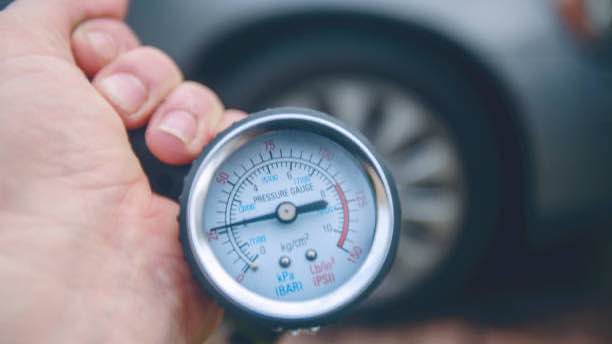
Step 2: Remove the valve cap from each tyre. Press a digital pressure gauge firmly onto the valve stem until the reading stabilises.
Step 3: Compare your reading to the correct figure for your load condition (use the tables above).
Step 4: If underinflated, add air or nitrogen in small amounts and recheck. If overinflated, press the pin inside the valve stem to release air slowly.
Step 5: Replace all four valve caps. Missing valve caps are a common cause of slow pressure loss — the cap protects the valve core from dust and road spray.
Check frequency for Crysta: Every 2 weeks minimum. Before any long-distance drive. After any significant pothole impact. Pre-monsoon (May) and post-monsoon (November) season checks are especially important.
Tyre Pressure by Driving Condition — Quick Reference
| Driving Condition | Front | Rear | Notes |
|---|---|---|---|
| City (1–4 passengers) | 33 PSI | 33 PSI | Standard daily setting |
| City (5–7 passengers) | 33 PSI | 36 PSI | Increase rear before loading |
| Highway (1–4 passengers) | 34 PSI | 34 PSI | +1 PSI for sustained speed |
| Highway (5–7 passengers) | 34 PSI | 37 PSI | Maximum safe highway pressure |
| Overnight parking | Check cold next morning | — | Pressure drops in cold night air |
| After monsoon rain | Check — waterlogged roads accelerate micro-leaks | — | Weekly check essential |
Signs Your Crysta’s Tyre Pressure Is Wrong
Underinflated (too low):
- Steering feels heavy or vague, especially at low speeds
- Fuel economy drops noticeably (1–2 kmpl worse in city)
- Tyres look visually “squished” at the bottom when parked
- Inner and outer edges of the tread wear faster than the centre
- Tyres run noticeably hot after short drives
Overinflated (too high):
- Ride is harsh — every speed bump and pothole is jarring
- Centre of the tread wears faster than the edges
- Car feels “bouncy” and loses traction on wet roads
- Steering feels light and twitchy at highway speeds
If you see either pattern on your Crysta’s tyres, get a free inspection at Tyre Torque — we’ll check pressure, assess tread wear, and tell you if uneven wear has already caused lasting damage.
Innova Crysta Tyre Sizes — Full Variant Breakdown
| Variant | Engine | Tyre Size | Wheel |
|---|---|---|---|
| G MT 7/8 Seater | 2.4 Diesel | 205/65 R16 | 16″ Steel/Alloy |
| G Plus 7/8 Seater | 2.4 Diesel | 205/65 R16 | 16″ Alloy |
| GX 7/8 Seater | 2.4 Diesel | 205/65 R16 | 16″ Alloy |
| VX 7 Seater | 2.4 Diesel | 205/65 R16 | 16″ Alloy |
| VX 8 Seater | 2.4 Diesel | 205/65 R16 | 16″ Alloy |
| ZX 7 Seater | 2.4 Diesel | 215/55 R17 | 17″ Alloy |
| GX AT/MT 7/8 Seater | 2.7 Petrol | 205/65 R16 | 16″ Alloy |
| VX 7 Seater | 2.7 Petrol | 205/65 R16 | 16″ Alloy |
| ZX AT 7 Seater | 2.7 Petrol | 215/55 R17 | 17″ Alloy |
| GX AT 7/8 Seater | 2.8 Diesel | 205/65 R16 | 16″ Alloy |
| ZX AT 7 Seater | 2.8 Diesel | 215/55 R17 | 17″ Alloy |
Not sure of your exact variant? Check the RC (Registration Certificate) — tyre size is listed there. Or check the driver’s door B-pillar sticker.
Frequently Asked Questions
Q: What is the correct tyre pressure for Innova Crysta? 33 PSI front and rear for normal load (up to 4 passengers). Increase rear to 36 PSI for full load (5–7 passengers and luggage). Always check cold.
Q: What is the tyre pressure for Innova Crysta 2.4 diesel? Same as all Crysta variants: 33 PSI front and rear (normal load), 33 front / 36 rear (full load). The 2.4 diesel engine’s extra weight over the front axle is already accounted for in this setting.
Q: What is the tyre pressure for Innova Crysta 2.8 diesel? Identical settings: 33/33 PSI (normal), 33/36 PSI (full load). The 2.8 engine is heavier but Toyota’s recommended pressure is the same across both diesel variants.
Q: What should be the front and back air pressure in Innova Crysta? Front: 33 PSI in all load conditions. Rear: 33 PSI (light load) or 36 PSI (full load of 5–7 passengers). For highway driving with full load, 34 front / 37 rear.
Q: What tyre pressure for Innova Crysta 17-inch ZX variant? Same as 16-inch: 33 PSI front and rear (normal), 33/36 PSI (full load). The larger 215/55 R17 tyre uses the same pressure settings as the 205/65 R16.
Q: How often should I check tyre pressure on Innova Crysta? Every 2 weeks for daily-use vehicles. Before every long-distance drive. After any significant pothole impact. The Crysta’s heavier weight makes underinflation consequences more severe than a typical hatchback.
Q: Can I use nitrogen in Innova Crysta tyres? Yes — and it’s recommended. Nitrogen holds pressure more consistently across Bangalore’s temperature swings and the Crysta’s variable load conditions. At Tyre Torque, nitrogen refilling is free.
Q: My Crysta TPMS light is on after I filled air. What do I do? Drive above 25 kmph for 10–15 minutes — the system usually resets automatically. If the light stays on, the TPMS sensor may need replacement or the valve core is faulty. Bring it to Tyre Torque for a free diagnosis.
Get Your Innova Crysta Tyres Checked at Tyre Torque, Bangalore
At Tyre Torque — NV Tyre Centre in Kasturi Nagar, Bangalore, we see Innova Crystas every day — school vans, corporate cabs, family-owned vehicles covering 2,000+ km/month. We know exactly what these vehicles need.
What we offer every Innova Crysta owner:
- 💨 Free nitrogen filling — all four tyres, every visit
- 🔍 Free tyre inspection — pressure, tread depth, sidewall check
- 🎯 3D wheel alignment — critical for a 1,900 kg MPV
- ⚖️ Wheel balancing — eliminates steering vibration at highway speeds
- 🏷️ Best tyre brands for Crysta — MRF, CEAT, Goodyear, Michelin, Apollo, Bridgestone
- 🔧 TPMS diagnosis — free assessment if your warning light won’t reset
- 🍄 Mushroom puncture repair — the safe repair for tubeless tyres
📍 Kasturi Nagar Main Road, Near CMR College, Next to Nayara Petrol Station, Chikka Banaswadi, Bangalore — 560043
📞 +91-72041-01993 🌐 www.tyretorque.in
Free Tyre Check for Your Crysta | Best Tyres for Innova Crysta in Bangalore
Published by Tyre Torque | Updated September 2026 | Bangalore’s trusted tyre specialist
Also read: