You’re cruising at 80 km/h on the Outer Ring Road, music on, windows up — and then you feel it. A low hum turns into a shimmy. The steering wheel starts trembling in your hands. By the time you hit 100 km/h, it’s a full-blown vibration you can feel through your seat.
You slow down. It stops. You speed up. It’s back.
This is one of the most common complaints we hear at Tyre Torque from Bangalore drivers — and it’s also one of the most misunderstood. Most people assume it’s “just a balancing issue” and leave it at that. Sometimes they’re right. But more often, that vibration is your car telling you something specific — and if you don’t listen, a ₹600 fix quietly becomes a ₹15,000 problem.
In this guide, we’ll walk you through the 5 most common reasons cars vibrate at high speed, how to tell which one is affecting your car, and exactly what it costs to fix in Bangalore.
First: Why Does Vibration Happen Specifically at High Speed?
At low speeds — say, below 40 km/h — small imbalances and irregularities in your tyres and wheels are easy for your suspension to absorb. They get smoothed out before they reach your steering wheel or seat.
But at higher speeds, your wheels are rotating significantly faster. A wheel spinning at 90 km/h completes roughly 13 full rotations every second. Any minor imbalance, bend, or irregularity now cycles through 13 times per second — amplifying the force until it’s impossible for your suspension to dampen. What was invisible at 40 km/h becomes a steering shimmy at 80 km/h and a full shake at 100 km/h.
This is why high-speed vibration almost always points to something in the wheel-tyre-suspension system. The speed is the amplifier; the underlying problem is the root cause.
Now, let’s identify which of the five is yours.
Reason #1: Unbalanced Wheels — The Most Common Culprit
What’s happening: Every tyre and wheel assembly has a centre of gravity. When that centre isn’t perfectly aligned with the wheel’s rotation axis — even by just a few grams — the wheel wobbles rather than spinning cleanly. At low speeds, this wobble is negligible. At highway speeds, it becomes the vibration you’re feeling.
Wheels go out of balance over time for several reasons: balance weights falling off (common after a pothole hit), uneven tyre wear, or tyre pressure loss on one wheel.
How to tell it’s this: The vibration begins at a specific speed — usually around 70–90 km/h — and may actually reduce slightly above 110 km/h. It’s typically felt in the steering wheel if the front wheels are unbalanced, or through the seat and floorboard if it’s the rear wheels.
The Bangalore factor: Bangalore’s roads are notorious for knocking balance weights loose. Every significant pothole hit — and there are dozens on the average commute through ITPL Main Road, Hennur Road, or Sarjapur Road — can shift your wheel balance enough to cause noticeable vibration at speed.
The fix: Wheel balancing on a spin balancer. A technician mounts each wheel on the machine, identifies the heavy spots, and applies small adhesive or clip-on weights to counterbalance them. The process takes about 15–20 minutes per wheel.
What it costs in Bangalore:
- Standard spin balancing: ₹300–₹500 per wheel (₹1,200–₹2,000 for a set of 4)
- Road Force balancing (detects issues standard spin balancers miss): ₹600–₹800 per wheel
At Tyre Torque, we use Road Force balancing equipment — the same technology used by BMW and Mercedes dealerships. Standard spin balancers identify weight imbalance, but Road Force balancing also detects tyre radial force variation (where the tyre itself is slightly out of round). We regularly fix vibrations that three or four previous “balancing” visits at other shops couldn’t solve.
How often: Every 10,000 km, or immediately after any significant pothole impact.
Reason #2: Wheel Misalignment — The Slow Destroyer
What’s happening: Wheel alignment refers to the angles at which your tyres contact the road — specifically, three measurements called toe, camber, and caster. When a wheel is out of alignment, it isn’t pointing exactly where it should. Instead of rolling cleanly forward, it’s scrubbing slightly sideways with every rotation.
At high speeds, this scrubbing creates directional instability that manifests as vibration — but more insidiously, it also causes one side of each tyre to wear much faster than the other.
How to tell it’s this: The vibration is accompanied by your car drifting or pulling to one side even on a straight road. You’ll also notice uneven tyre wear — if you look at your tyres and one edge is significantly more worn than the other, misalignment has been at work for a while. The vibration from misalignment tends to be more of a “wander” or shimmy rather than a tight high-frequency buzz.
The Bangalore factor: Alignment takes a beating on Bangalore roads. A single hard pothole hit at 60 km/h can knock a wheel 0.5° out of spec — which sounds small, but is enough to cause measurable tyre scrub and vibration. Silk Board junction, Marathahalli Bridge, Old Madras Road — if you commute on any of these daily, your alignment deserves checking every 8,000–10,000 km.
The fix: 3D computerised wheel alignment. The car is driven onto an alignment rack, sensors are attached to all four wheels, and a computer reads the exact angles of each wheel simultaneously. The technician then adjusts the angles using the car’s alignment bolts until everything matches the manufacturer’s specification.
The critical difference in alignment technology:
| Method | Accuracy | What It Measures |
|---|---|---|
| Manual (tape measure) | ±0.5° | Toe only, roughly |
| 2D alignment | ±0.2° | Front toe and camber |
| 3D computerised (Hunter) | ±0.01° | All 4 wheels, all angles simultaneously |
Manual alignment — still offered at roadside shops across Bangalore — cannot reliably fix a vibration issue. The tolerance is simply too wide. 3D alignment is the standard worth paying for.
What it costs in Bangalore:
- 3D computerised alignment: ₹1,200–₹1,800 (standalone)
- Free with tyre purchase at Tyre Torque
How often: Every 8,000–10,000 km, after any significant pothole impact, after replacing suspension components, and whenever you buy new tyres.
Reason #3: Tyre Damage — The Risk You Can See (If You Look)
What’s happening: Your tyre isn’t just rubber — it’s a complex multi-layered construction of rubber compounds, steel belts, nylon cords, and a bead wire. When this internal structure is compromised — by a sharp pothole impact, overloading, or long-term underinflation — the damage shows up in ways that create vibration.
The three most common tyre damage types that cause high-speed vibration:
Sidewall bulge: A pothole impact breaks the internal cord structure, allowing the inner air pressure to push outward through the weakened spot. The result is a visible bubble or egg-shaped bulge on the sidewall. Every rotation of this tyre creates a rhythmic thump and vibration — and more importantly, this is a tyre that can blow out at highway speed with zero warning.
Flat spot: When a car sits stationary for an extended period, the weight of the vehicle deforms the section of tyre touching the ground. The tyre develops a flat spot that causes a rhythmic thumping at low speeds which typically disappears once the rubber warms up — but in severe cases, the deformation is permanent.
Belt separation / cupping: Internal belt separation causes the tyre to lose its circular shape. Cupping (also called scalloping) creates a wavy wear pattern across the tread, generating a noise and vibration that many drivers initially mistake for wheel imbalance — and that balancing alone will never fix.
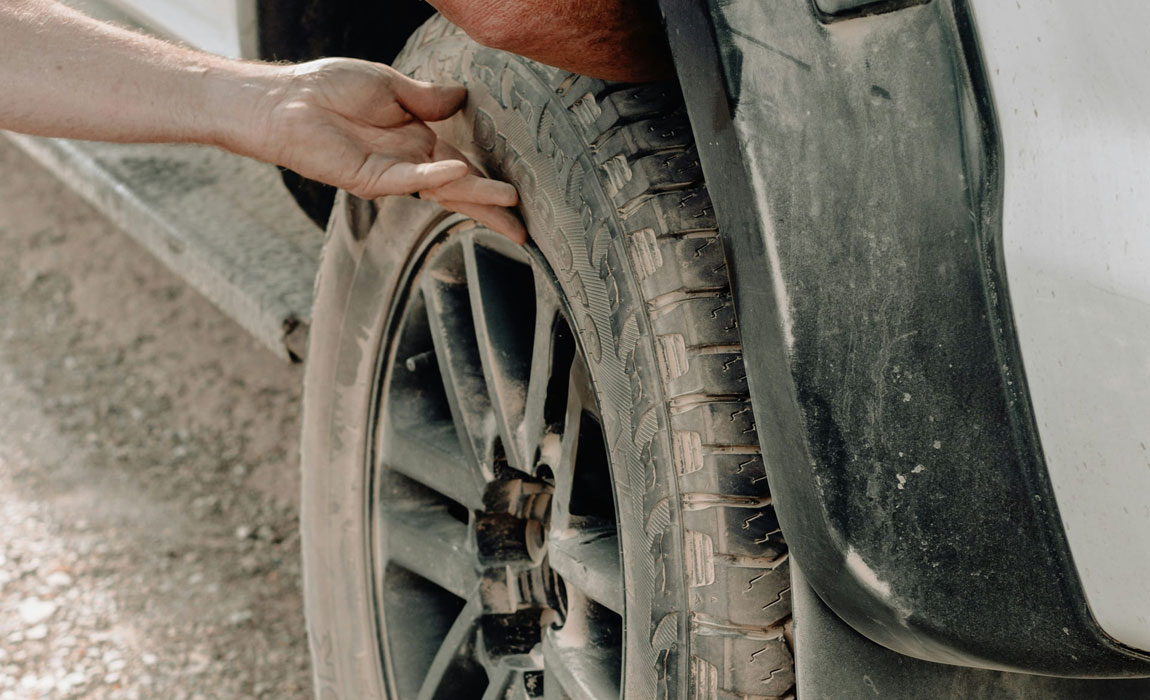
How to tell it’s this: Get down and physically inspect each tyre. Run your hand across the tread surface — if you feel ridges, waves, or high-and-low patches, the tyre is cupped. Look at each sidewall for any bulge or bubble. A bulged tyre must be replaced immediately — do not drive it at highway speed.
The Bangalore factor: Bangalore’s sharp-edged potholes are particularly brutal on sidewalls. The impact isn’t just a compression — it’s a shear force that cuts into the internal cords. Chikka Banaswadi, Hennur Main Road, and virtually any road after the first monsoon rains are riddled with the kind of sharp-lipped potholes that cause sidewall damage.
The fix:
- Sidewall bulge: Replace the tyre immediately. No repair is possible.
- Cupping/scalloping: Replace the tyre and diagnose the root cause (often worn shock absorbers)
- Flat spot: May resolve with driving in minor cases; replace if persistent
What it costs:
- Tyre replacement: ₹4,500–₹14,000 per tyre, depending on car and brand
- Free tyre inspection at Tyre Torque (we check for this during every visit)
Reason #4: Bent or Damaged Alloy Wheels — The One That Fools Everyone
What’s happening: A bent rim is the vibration cause that most often gets misdiagnosed — because the car keeps going back to the shop for “balancing,” vibration persists, and no one thinks to check the wheel itself.
When a rim bends from a pothole or kerb impact, the tyre no longer rotates in a perfect circle. Instead, it traces a slight ellipse with every rotation. At speed, this irregular path creates a strong vibration — and because the tyre is seated on the bent rim, adding balance weights won’t fix it. The tyre is physically incapable of spinning true no matter how perfectly it’s balanced.
How to tell it’s this: The vibration began after a specific incident — a hard pothole hit, clipping a kerb, driving through a flooded road with a hidden obstacle. Standard balancing has been done but vibration persists. Ask a technician to put the wheel on a balancing machine and watch for “runout” — if the wheel wobbles laterally or radially as it spins, the rim is bent.
The Bangalore factor: Bangalore’s road edges and kerb drops are particularly hard on alloy wheels. The NICE Road and Mysore Expressway have wide lanes, but getting onto them involves navigating sharp-edged entry ramps and damaged service roads. And the monsoon season hides potholes under water, making unavoidable impacts more common.
The fix:
- Steel rims: Can often be straightened for ₹500–₹1,200
- Alloy rims (minor bend): Heat straightening and refinishing ₹1,500–₹3,500
- Alloy rims (severe damage): Replacement ₹5,000–₹20,000 depending on size and brand
Important: Cracked alloy wheels cannot be safely repaired — they must be replaced. If you can see a crack in the rim (even a hairline crack near the spoke), do not drive at highway speed. A rim failure at 100 km/h is catastrophic.
At Tyre Torque, our Road Force balancing equipment detects both weight imbalance AND wheel runout in the same test. A customer once came to us after three failed “balancing” attempts at other shops. We put the car on the Road Force machine, identified a 1.8mm bend in the front left alloy, and referred them for rim repair. Problem solved in 45 minutes.
Reason #5: Worn Suspension or Steering Components — The Vibration That Gets Worse Over Time
What’s happening: Your suspension and steering systems are held together by a set of joints, bushings, and links designed to allow controlled movement while keeping the wheel planted firmly on the road. Over time — especially on Indian roads — these components wear out.
When they develop play or looseness, the wheel is no longer held precisely in position. At low speeds, the suspension can compensate. At high speeds, the looseness allows the wheel to wander slightly with every bump, and you feel it as vibration, shimmy, or a vague, imprecise steering feel.
The components most commonly found in Bangalore cars:
Tie rod ends: Connect the steering rack to the wheels. Worn tie rods allow the front wheels to wander, causing steering vibration and imprecise handling. Lifespan: 60,000–100,000 km in Indian conditions.
Ball joints: Connect the control arm to the wheel hub. Worn ball joints create clunking over bumps and contribute to vibration at speed. Can also cause dangerous handling loss if they fail.
Shock absorbers/struts: When shocks lose their damping ability, the wheel bounces more with every road irregularity — amplifying vibration instead of absorbing it. A classic sign is tyres developing cupping wear (reason #3 and reason #5 are often connected).
Control arm bushings: Rubber bushings that allow controlled movement. When they crack or harden, they transmit road impacts directly into the chassis rather than absorbing them.
How to tell it’s this: Vibration from worn suspension tends to feel less precise than tyre/wheel vibration. It’s more of a vague shimmy or “floaty” feeling, often accompanied by clunking sounds over speed breakers or potholes. The steering feels less connected to the road. Cars above 70,000–80,000 km with no suspension service history are prime candidates.
The Bangalore factor: This is where Bangalore’s roads really take a toll. The sheer volume of potholes, speed breakers (which are often extreme in residential areas), and the general road surface quality accelerates suspension wear significantly compared to cars driving on smoother roads. A car in Bangalore often needs its first suspension inspection at 50,000 km — significantly earlier than the standard 80,000 km recommendation.
The fix: Individual component replacement based on inspection. Tie rod ends and ball joints are standard replacements. Shock absorbers are replaced in pairs (both fronts or both rears).
What it costs:
- Tie rod end replacement (per side): ₹1,500–₹3,500
- Ball joint replacement (per side): ₹2,000–₹5,000
- Shock absorber replacement (per pair): ₹5,000–₹15,000 depending on brand and vehicle
Note: After any suspension component replacement, wheel alignment is mandatory. The new part will have changed the wheel’s geometry, and without realignment, you’ll wear your new tyres unevenly within weeks.
Quick Diagnosis Guide: Which Vibration Is Yours?
Use this table to narrow down the cause before visiting a workshop:
| Symptom | Most Likely Cause |
|---|---|
| Vibration starts at ~80–90 km/h, may reduce above 110 | Wheel imbalance |
| Car pulls left or right + uneven tyre wear | Wheel misalignment |
| Rhythmic thumping that’s there even at 40–50 km/h | Tyre flat spot or cupping |
| Visible bubble/bulge on tyre sidewall | Tyre sidewall damage — replace immediately |
| Balancing done multiple times, vibration persists | Bent alloy wheel |
| Vibration + clunking over bumps + vague steering | Worn suspension/steering components |
| Vibration only when braking from high speed | Warped brake rotors (separate issue) |
| Vibration only under acceleration, not cruising | CV joint or engine mount issue |
The Cost of Ignoring It
Here’s what happens when you drive on a vibrating car and hope it resolves itself:
A minor wheel imbalance (₹1,600 to fix) causes uneven tyre wear. The tyres need replacement 15,000 km early (₹20,000+). The uneven wear has also been stressing the wheel bearings and suspension bushings, which now need attention, too. What started as a ₹1,600 problem has become a ₹35,000–₹45,000 repair bill.
This is not an unlikely scenario — it’s the exact pattern we see regularly at Tyre Torque. The vibration is a warning signal. Ignoring it doesn’t make the underlying problem go away; it makes it progressively more expensive.
What to Do Right Now
If your car is vibrating at high speed, here’s the right sequence:
Step 1 — Visual check yourself. Look at each tyre for visible bulges, obvious damage, or severely uneven wear. Check tyre pressures (a tyre running 10+ PSI low can amplify any existing vibration). If you see a sidewall bulge, do not drive at highway speed — visit a tyre shop today.
Step 2 — Bring it in for a free inspection. Don’t guess, and don’t pay for the wrong service. At Tyre Torque, we do a comprehensive free tyre inspection and can identify the root cause — whether it’s balance, alignment, tyre damage, rim damage, or suspension — before recommending anything.
Step 3 — Fix in the right order. The correct sequence matters. Suspension issues must be fixed before alignment. Alignment must be done before balancing. Balancing must be checked after any tyre replacement. Skipping the sequence means the earlier fix is undone by the later problem.
Fix Your Car’s Vibration at Tyre Torque, Bangalore
At Tyre Torque – NV Tyre Centre, we’re equipped to diagnose and fix every cause of high-speed vibration — from a simple rebalance to full 3D alignment and suspension inspection.
What we offer:
- ✅ Free tyre inspection and vibration diagnosis
- ✅ Road Force balancing — detects issues standard machines miss
- ✅ Hunter 3D computerised wheel alignment (±0.01° precision)
- ✅ All major tyre brands in stock for same-day replacement
- ✅ Alloy wheel damage assessment
- ✅ Transparent, fixed pricing — no surprise charges
📍 Kasturi Nagar Main Road, Near CMR College, Next to Nayara Petrol Station, Chikka Banaswadi, Bangalore – 560043 📞 +91-72041-01993 🌐 www.tyretorque.in 🕘 Open 7 days | 8:00 AM – 8:00 PM
If your car is shaking above 80 km/h, don’t wait until the problem compounds. Come in, and we’ll tell you exactly what’s causing it — and exactly what it will cost to fix — before we touch anything.
Frequently Asked Questions
Q: Is it safe to drive a vibrating car? A: It depends on the cause. Minor imbalance at city speeds is generally safe for short distances. A sidewall bulge, severe vibration, or vibration accompanied by loose steering should be addressed immediately — do not drive at highway speed with these symptoms.
Q: My car only vibrates above 90 km/h. Is that still urgent? A: Yes. The fact that it appears at 90 km/h means you’re driving into the problem zone every time you reach highway speed. The underlying cause — almost certainly imbalance or a bent rim — will progressively worsen and cause tyre wear that shortens tyre life significantly.
Q: I just got my tyres balanced. Why is the vibration still there? A: Standard spin balancing only corrects weight imbalance. If the vibration persists after balancing, the cause is likely a bent rim, tyre radial force variation, misalignment, or a suspension component issue. Road Force balancing detects the issues a spin balancer cannot.
Q: How often should I get wheel balancing done in Bangalore? A: Every 10,000 km as standard maintenance — and immediately after any significant pothole impact. Given Bangalore’s road conditions, many regular commuters benefit from checking it every 6,000–8,000 km.
Q: Does wheel alignment fix vibration? A: Alignment corrects the wheel’s direction and position, which reduces tyre scrubbing and uneven wear. It reduces vibration caused by misalignment, but it won’t fix vibration caused by imbalance or tyre damage — those need separate attention. Alignment and balancing are different services and should ideally be done together.