You walk into a tyre shop in Bangalore and the technician tells you: “Sir, your alignment is gone and your wheels need balancing too.”
Most car owners hear this and think — aren’t those the same thing? Or they nod along, unsure whether they’re being upsold or whether this is genuinely necessary.
Here’s the truth: wheel alignment and wheel balancing are two completely different services. They fix different problems, use different equipment, cost different amounts, and are needed at different times. Confusing the two — or ignoring either one — can quietly destroy your tyres, hurt your fuel efficiency, and make your car unsafe to drive on Bangalore’s demanding roads.
This guide explains everything clearly, without the jargon. By the end, you’ll know exactly what each service does, how to spot when you need it, how much it costs in Bangalore, and which one your car needs right now.
The Simple Difference — In One Line Each
Wheel Alignment = adjusting the angles of your wheels so they point in the right direction and make proper contact with the road.
Wheel Balancing = correcting the weight distribution of your tyre-and-wheel assembly so it spins evenly without vibrating.
Think of it this way:
Alignment is about direction. Balancing is about smoothness.
A car with bad alignment pulls to one side. A car with bad balance shakes at speed. Both are problems. Both need to be fixed — but they require different tools and different fixes.
What Is Wheel Alignment?
Wheel alignment — sometimes called tyre alignment or tracking — refers to adjusting the suspension system that connects your wheels to your car. It is not the tyres or wheels themselves being adjusted. It is the angles at which they sit.
When your wheels are properly aligned, all four tyres are pointing in exactly the right direction, making full, even contact with the road surface, and working together as they should. When alignment is off — even slightly — your car fights itself every time it moves forward.
The Three Alignment Angles Explained Simply
There are three key angles that a technician checks and adjusts during wheel alignment:
1. Toe Toe refers to whether the front edges of your tyres point inward (toe-in) or outward (toe-out) when viewed from above — like how a person’s feet can point straight, turn inward (pigeon-toed), or flare out. Incorrect toe is the most common cause of rapid, uneven tyre wear.
2. Camber Camber is the tilt of your tyre when viewed from the front of the car. If the top of the tyre leans outward, it’s positive camber. If it leans inward, it’s negative camber. Too much tilt in either direction causes one edge of your tyre to wear far faster than the other — and affects cornering grip.
3. Caster Caster is the angle of the steering axis when viewed from the side of the car. It affects steering stability and how your car returns to centre after a turn. Most drivers never notice caster issues directly, but they affect how the car feels on highways at higher speeds.
What Causes Wheel Misalignment in Bangalore?
Bangalore’s roads are simultaneously some of the most pothole-ridden and most heavily used in India. This creates an almost perfect environment for knocking your wheel alignment out:
- Potholes — the single biggest culprit. One hard hit on Outer Ring Road, Bellary Road, or any inner-city road can shift your alignment immediately
- Curb hits — brushing or mounting a kerb when parking, or during tight U-turns on narrow roads
- Speed breakers — hitting them at speed repeatedly over time causes gradual misalignment
- Minor accidents — even a low-speed bump in parking lots can shift alignment without visible body damage
- Worn suspension parts — ball joints, tie rods, and control arm bushings wear over time and cause alignment drift naturally
Signs Your Car Needs Wheel Alignment
You don’t need a mechanic to tell you your alignment is off. Your car will tell you — if you know what to look for:
✅ The car pulls left or right — you’re driving on a straight road but have to keep correcting the steering wheel to stay straight ✅ Steering wheel is off-centre — your steering wheel isn’t centred when driving straight (it points slightly left or right) ✅ Uneven tyre wear — one side of your tyre tread is wearing down significantly faster than the other ✅ Car feels “loose” or wanders — the car doesn’t feel planted; it drifts slightly rather than tracking straight and true ✅ Squealing tyres on turns — a sign that tyre angles are making rubber scrub against the road incorrectly
Bangalore-specific tip: If you’ve recently driven through the stretch near Silk Board, Hebbal flyover, or the KR Puram bridge area — all notorious for sudden deep potholes — get your alignment checked immediately, even if you don’t feel obvious symptoms yet.
How Is Wheel Alignment Done?
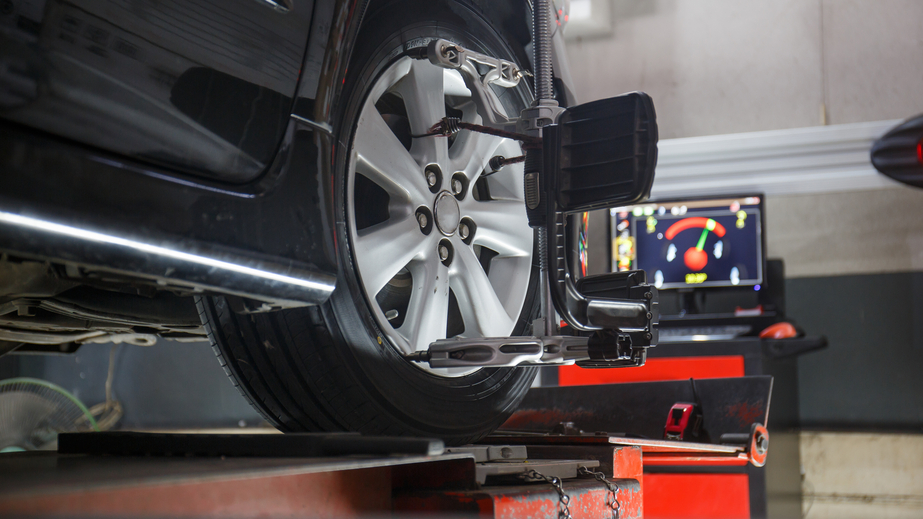
At a reputable shop like Tyre Torque, wheel alignment is done using a 3D computerised alignment machine. Precision sensors are mounted on all four wheels. The system measures the exact angle of every wheel in real time and compares them against the manufacturer’s specifications for your specific car model.
The technician then makes adjustments to the suspension components — tie rods, camber bolts, and other linkages — until all four wheels are back within spec. A printout is generated showing before-and-after measurements, so you can see exactly what was corrected.
The entire process takes 45–60 minutes for most cars.
What Is Wheel Balancing?
While alignment is about angles, wheel balancing is about weight. Every tyre and wheel assembly — even a brand-new one fresh from the factory — has tiny imperfections in weight distribution. One section of the wheel might be marginally heavier than another. At low speeds, you won’t notice. But as speed increases, that slight imbalance causes the wheel to wobble or bounce — and you feel it as vibration in the steering wheel, the floor, or the seat.
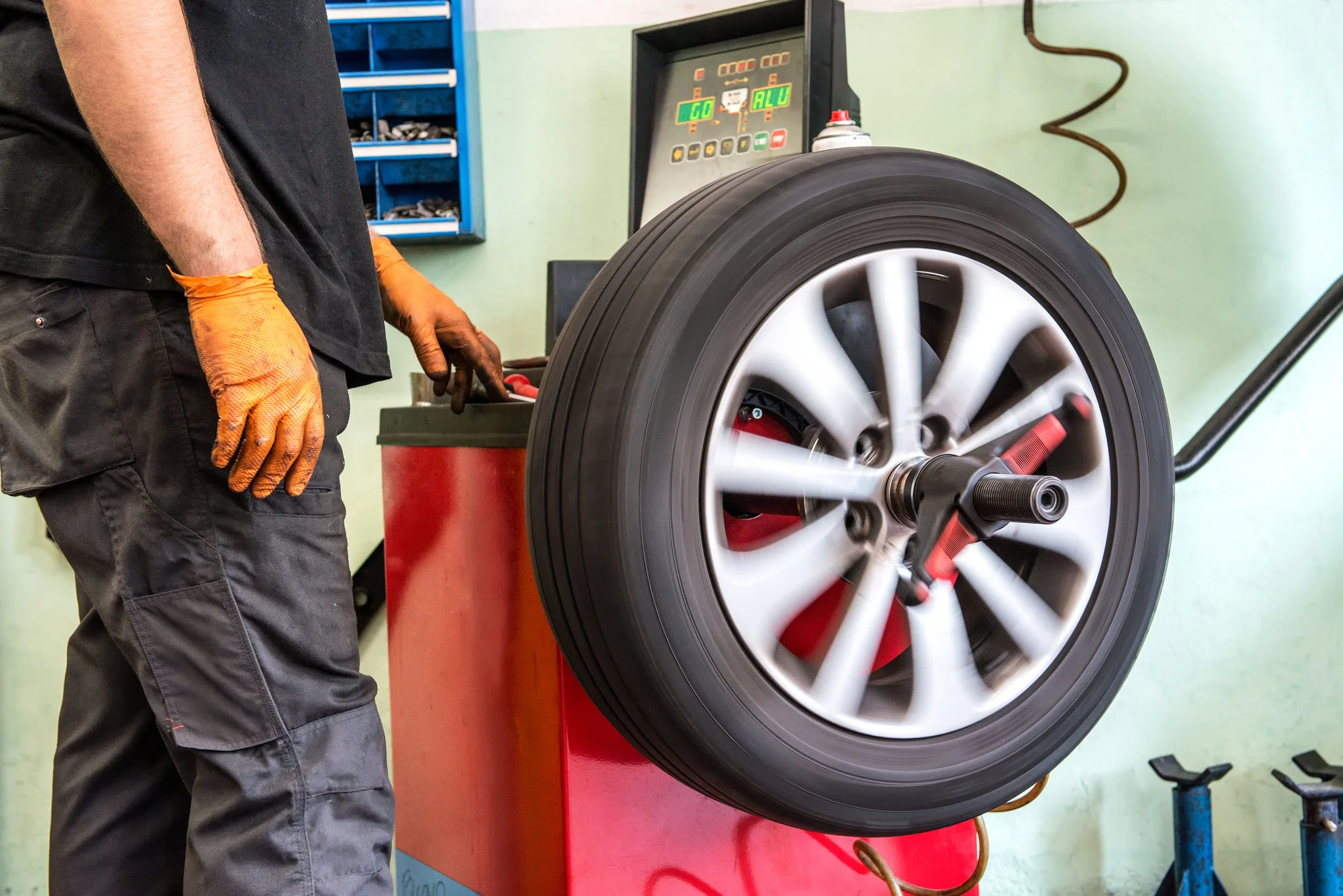
Wheel balancing corrects this by identifying exactly where the heavy spot is on the wheel assembly and adding small counterweights — typically small metal clips — to the opposite side of the rim to even things out.
Two Types of Wheel Balancing
Static Balancing Addresses weight imbalance in a single plane — essentially up-and-down wobble. An older technique used for simpler wheel types.
Dynamic Balancing Addresses imbalance in both the vertical and horizontal planes simultaneously — the gold standard for modern tyres. This is what reputable shops in Bangalore use, done on a computerised spin-balancing machine. The wheel is mounted on the machine, spun at speed, and sensors pinpoint exactly where and how much weight needs to be added.
What Causes Wheel Imbalance?
- Brand new tyre fitment — new tyres always need balancing after mounting; no exceptions
- Pothole impacts — same culprit as alignment — a hard hit can knock weights off the rim or shift weight distribution
- Lost wheel weights — small balancing weights can fall off over time, especially on rough roads
- Tyre wear — as a tyre wears unevenly, the weight distribution shifts
- Tyre rotation — after rotating tyres to a different position, rebalancing is recommended
Signs Your Car Needs Wheel Balancing
Balancing symptoms are more physical and immediate than alignment symptoms:
✅ Vibration in the steering wheel — especially noticeable at certain speeds (typically 60–90 km/h) and can ease at higher or lower speeds ✅ Vibration in the floorboard or seat — if the imbalance is in the rear wheels, you’ll feel it through the seat or floor rather than the steering ✅ Increased road noise — a humming or droning sound that gets louder with speed ✅ Scalloped or cupped tyre wear — instead of even wear across the tread, you see dips or scallops — the tyre has been bouncing rather than rolling smoothly ✅ Car feels “floaty” at highway speed — the ride feels less planted and more nervous as speed increases
Wheel Alignment vs Wheel Balancing — Side-by-Side Comparison
| Factor | Wheel Alignment | Wheel Balancing |
|---|---|---|
| What it fixes | Incorrect wheel angles | Uneven weight distribution |
| Main symptom | Car pulls to one side | Steering/seat vibrates at speed |
| What’s adjusted | Suspension angles (camber, toe, caster) | Small weights added to wheel rim |
| Equipment used | 3D computerised alignment rack | Computerised spin balancer |
| How long it takes | 45–60 minutes | 20–30 minutes |
| Cost in Bangalore | ₹499 – ₹800 (4-wheel) | ₹100 – ₹200 per wheel |
| How often needed | Every 8,000–10,000 km | Every 5,000–8,000 km |
| Mandatory after new tyres? | Highly recommended | Absolutely yes |
| Effect if ignored | Uneven tyre wear, poor handling | Vibration, suspension damage |
Which One Do You Actually Need?
Use this simple checklist to figure out what your car is telling you:
You Need Wheel Alignment If:
- Your car pulls left or right on a straight, flat road
- Your steering wheel is visibly off-centre when driving straight
- You notice one edge of your tyre wearing faster than the other
- You recently hit a large pothole or mounted a kerb
- It’s been more than 8,000–10,000 km since your last alignment check
- You’ve just replaced suspension parts (tie rods, ball joints, control arms)
You Need Wheel Balancing If:
- You feel a vibration or shake in the steering wheel, especially between 60–90 km/h
- You feel vibration through the seat or floorboard
- You hear increased road noise or droning at highway speed
- You’ve just fitted new tyres (balancing is mandatory)
- It’s been 5,000–6,000 km since your last balance
You Need Both If:
- You’ve just bought a new set of tyres (always do both)
- You hit a severe pothole at speed (impacts affect both angles and weight)
- Your car pulls AND vibrates
- You haven’t had either done in over a year
In most cases, doing both together is the smartest move. The combined service takes under 90 minutes at a well-equipped shop and protects both your tyres and your suspension simultaneously.
What Happens If You Ignore Both?
This is where many Bangalore car owners make a costly mistake. Wheel alignment and balancing issues don’t announce themselves dramatically — they creep up gradually. But the damage they cause accumulates fast.
Ignoring Alignment:
- Tyres wear unevenly and need replacement 30–40% sooner — costing you ₹10,000–₹40,000 in premature tyre replacement
- Increased rolling resistance raises fuel consumption — you pay more at the pump every single day
- Strain on suspension components like ball joints and tie rods — these are expensive to replace (₹3,000–₹15,000 depending on the part and car model)
- Reduced handling and braking performance — your car is genuinely less safe in an emergency
Ignoring Balancing:
- Vibration transfers constant stress to wheel bearings, shock absorbers, and steering components
- Scalloped tyre wear makes tyres noisy, rough, and unsafe
- Increased fatigue and discomfort on every drive — particularly painful on Bangalore’s long commutes
- Wheel bearing failure — a serious and expensive consequence (₹4,000–₹12,000 to fix)
The cost of alignment and balancing in Bangalore is between ₹600 and ₹1,200 for a complete job. The cost of ignoring them is several times that.
Wheel Alignment & Balancing Cost in Bangalore (2026)
| Service | Cost at Tyre Torque | Typical Market Range |
|---|---|---|
| 2-Wheel Alignment | ₹349 | ₹300 – ₹600 |
| 4-Wheel Alignment | ₹499 | ₹499 – ₹900 |
| Wheel Balancing (per wheel) | ₹120 | ₹100 – ₹250 |
| Wheel Balancing (all 4 wheels) | ₹450 | ₹400 – ₹900 |
| Alignment + Balancing (combo) | ₹899 | ₹900 – ₹1,500 |
How Often Should You Get These Done?
Wheel Alignment — every 8,000–10,000 km, or any time you hit a significant pothole, after suspension repairs, or when you notice symptoms. Given Bangalore’s road conditions, annual checks are wise regardless of mileage.
Wheel Balancing — every 5,000–8,000 km, after every new tyre fitment, and any time you feel vibration at speed.
A good rule of thumb: get both done every time you rotate your tyres — typically every 8,000–10,000 km. This way, nothing gets overlooked and your tyres wear evenly across all four corners throughout their life.
Frequently Asked Questions
Q: Can I do wheel balancing without wheel alignment?
Yes, they are independent services. If you only have vibration symptoms with no pulling or uneven wear, balancing alone may solve the problem. However, if you’re already at the shop, doing both is always recommended for complete peace of mind.
Q: Does wheel alignment need to be done with every tyre change?
Yes — strongly recommended. New tyres on a misaligned car will wear unevenly from day one, shortening the life of your brand-new investment significantly.
Q: How do I know if it’s an alignment or balancing problem?
Simple: if your car pulls to one side, it’s likely an alignment. If you feel vibration or shaking, especially at certain speeds, it’s likely balancing. If both symptoms are present, you likely need both.
Q: Is wheel alignment the same as wheel balancing?
No, they are two completely different services addressing two different problems. Alignment corrects wheel angles; balancing corrects weight distribution. Always confirm which service you’re actually getting before agreeing to work.
Q: How long does wheel alignment last in Bangalore? Given Bangalore’s road conditions, alignment can be disturbed in as little as 5,000–8,000 km — much sooner than in cities with smoother roads. Annual checks are a minimum for Bangalore drivers.
Q: Can bad wheel alignment cause vibration? In severe cases, yes. But vibration is primarily a balancing issue. If you’re experiencing vibration AND the car is pulling, you likely have both problems simultaneously.
Get Wheel Alignment & Balancing Done Right in Bangalore
At Tyre Torque – NV Tyre Centre in Kasturi Nagar, we use advanced 3D computerised wheel alignment equipment and precision dynamic balancing machines to get your car back to factory-perfect spec — with a printout to prove it.
Every alignment and balancing job at Tyre Torque includes:
✅ 3D computerised alignment with before-and-after printout ✅ Dynamic wheel balancing on all 4 wheels ✅ Free tyre pressure check and nitrogen top-up ✅ Free visual tyre inspection ✅ Transparent pricing — no hidden charges
Whether your car is pulling on the way to Electronic City every morning, shaking on the NICE Road at 80 km/h, or you’ve just fitted new tyres — come in and we’ll sort it out properly, the first time.
📍 Tyre Torque – NV Tyre Centre Kasturi Nagar Main Road, Near CMR College, Next to Nayara Petrol Station, Chikka Banaswadi, Bangalore – 560043
📞 +91-72041-01993 🌐 www.tyretorque.in 🕘 Open 7 days a week | Walk-ins welcome | Same-day service available