Quick Answer: Two-wheeler tyres in Bangalore cost ₹900–₹2,000 for scooters (Activa, Jupiter, Access), ₹1,200–₹3,500 for commuter motorcycles (Splendor, Pulsar, Apache), and ₹3,000–₹15,000+ for premium and cruiser motorcycles (Royal Enfield, KTM, Harley-Davidson), depending on brand and size. JC Road remains Bangalore’s largest concentration of tyre dealers — including two-wheeler specialists — for exactly the reason car buyers already know it for: wholesale-adjacent pricing and the widest single-street selection of brands anywhere in the city. This guide breaks down which brand and tyre suits your specific two-wheeler, current 2026 pricing, and what to check before buying.
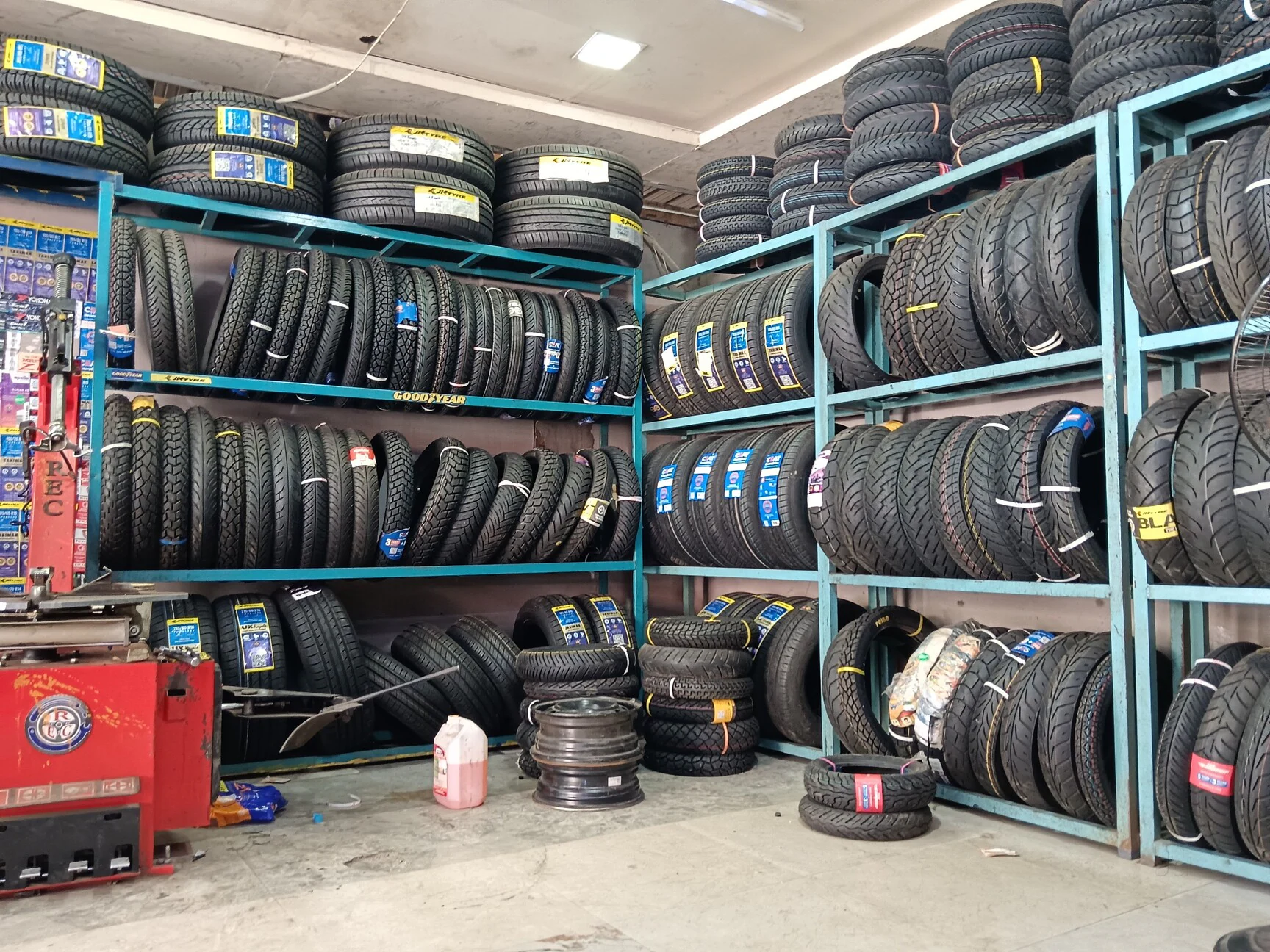
Why Bangalore Riders Specifically Need to Think About Tyre Choice
Two-wheeler tyres get less attention than car tyres, but the margin for error is smaller — a two-wheeler has exactly two contact patches with the road instead of four, and each is considerably smaller. Every issue that matters for car tyres in Bangalore — potholes, monsoon grip, heat cycling in traffic — matters more per square centimetre of rubber on a bike or scooter.
Bangalore’s pothole density hits two-wheelers harder. A car’s suspension absorbs a meaningful share of a pothole impact before it reaches the tyre. A two-wheeler has far less suspension travel and a rider’s body weight transferring more directly through the front tyre — the same ORR and Marathahalli stretches that stress car tyres cause faster wear and higher puncture risk on two-wheeler tyres.
Monsoon grip is a bigger safety factor on two wheels. A car sliding on a wet road is a handling problem. A two-wheeler losing grip on a wet road is a fall. Tread pattern and rubber compound matter disproportionately more here than for four-wheeled vehicles, which is why wet-weather-focused ranges like CEAT’s Zoom and Gripp series specifically call out monsoon performance as a selling point.
Daily commuting means faster wear. Most Bangalore two-wheeler owners use their vehicle for daily short-to-medium commutes through constant stop-start traffic — Silk Board, Marathahalli, Hebbal — which wears rear tyres in particular faster than steady highway riding would.
Two-Wheeler Tyre Brands in India — Which Suits Your Bike
MRF — The Market Leader
MRF holds the largest share of the two-wheeler tyre market in India, and for good reason — a genuinely wide range spanning scooters to premium motorcycles, strong availability, and tyres engineered specifically for Indian road conditions rather than adapted from international designs. The Nylogrip Plus and Zapper ranges cover the vast majority of commuter motorcycles and scooters on Bangalore roads.
Best for: Riders who want the safest, most widely-available default choice — Activa, Splendor, Pulsar owners doing standard daily commuting.
CEAT — Best Wet-Weather Performance
CEAT is the second-largest two-wheeler tyre brand in India, and its Zoom and Gripp ranges are specifically well-regarded for wet-weather grip — a genuinely relevant factor given Bangalore’s concentrated monsoon rainfall. Slightly more affordable than MRF for comparable quality in many sizes.
Best for: Riders who commute regardless of weather and prioritise confidence in the rain over marginal price savings.
TVS Eurogrip — Strong Value
TVS Eurogrip has gained significant market share in recent years through competitive pricing without a meaningful compromise on quality. The Protorq and Roadhound ranges are popular specifically on sport commuters (Apache, Pulsar-class bikes), often priced ₹200–₹500 below MRF for a comparable size.
Best for: Budget-conscious riders on sport-commuter motorcycles who still want a reasonably grippy, modern tread design.
Apollo — Newer but Competitive
Apollo entered the two-wheeler tyre segment more recently than MRF or CEAT but has built a genuinely strong reputation quickly. The Alpha series targets commuters, while the Tramplr range is aimed at cruiser-style motorcycles.
Best for: Riders wanting a middle ground between budget and premium, particularly on cruiser-style bikes where Tramplr is a strong fit.
Michelin — Premium Performance
Michelin’s two-wheeler range in India is more limited than its car tyre lineup, but the Pilot Street (commuter/sport) and City Pro (scooter/commuter) lines deliver genuinely premium grip and durability, at a 20–30% price premium over domestic brands.
Best for: Riders on premium motorcycles who want the best available wet and dry grip, and are willing to pay for it.
Two-Wheeler Tyre Prices in Bangalore — 2026 Guide
Scooters
| Model | Common Size | Price Range (Per Tyre) |
|---|---|---|
| Honda Activa | 90/100-10 (front/rear) | ₹1,150 – ₹1,600 |
| TVS Jupiter | 90/90-12 | ₹1,300 – ₹1,700 |
| Suzuki Access | 90/90-12 (F) / 90/100-10 (R) | ₹1,150 – ₹1,600 |
Commuter Motorcycles
| Model | Common Size | Price Range (Per Tyre) |
|---|---|---|
| Hero Splendor | 2.75-18 (F) / 3.00-18 (R) | ₹900 – ₹1,500 |
| Bajaj Pulsar (125–150cc) | 90/90-17 (F) / 120/80-17 (R) | ₹2,200 – ₹4,800 |
| TVS Apache | 90/90-17 (F) / 130/70-17 (R) | ₹2,500 – ₹5,000 |
Premium & Cruiser Motorcycles
| Model | Common Size | Price Range (Per Tyre) |
|---|---|---|
| Royal Enfield Classic/Bullet | 90/90-19 (F) / 110/90-18 (R) | ₹2,800 – ₹6,000 |
| Royal Enfield Continental GT/650 twins | Varies by size | ₹4,000 – ₹9,000 |
| KTM Duke series | Varies by size | ₹5,000 – ₹12,000+ |
What drives the price within each range: tube-type versus tubeless construction (tubeless generally costs more but is significantly safer, since it deflates gradually rather than instantly on a puncture), radial versus bias-ply construction on larger motorcycles, and brand — a domestic brand and a premium international brand in the identical size can differ by 30–50% or more.
Tube-Type vs Tubeless — Why It Matters More on Two Wheelers
This distinction matters more for two-wheelers than for cars, because a two-wheeler puncture is a more urgent safety event than a car puncture.
Tube-type tyres use a separate rubber tube inside the tyre casing to hold air. When punctured, a tube-type tyre typically deflates rapidly — sometimes within seconds — because the puncture point isn’t self-sealing in any way. This is more dangerous at speed on a two-wheeler than in a car, since sudden rear-wheel deflation at speed can destabilise the bike.
Tubeless tyres hold air directly within the tyre casing itself, with no separate tube. A puncture typically causes gradual deflation over minutes rather than seconds, giving the rider time to slow down and pull over safely — a meaningful safety advantage, particularly relevant on Bangalore’s pothole-and-debris-heavy roads.
Not every bike can simply switch. Many older motorcycles and most spoke-wheel Royal Enfield variants are built around tube-type tyres because the spoke design doesn’t create an airtight seal at the rim the way alloy wheels do. Check whether your specific bike and wheel type support tubeless before assuming you can upgrade.
Signs Your Two-Wheeler Tyre Needs Replacement
Tread wear indicator (TWI) reached. Like car tyres, two-wheeler tyres have small raised bars moulded into the tread grooves marking the legal minimum depth (1.6mm). Once the tread is flush with these markers, replace immediately — grip, especially in wet conditions, drops sharply below this point.
Tyre age over 5 years, regardless of remaining tread — the rubber compound hardens and loses grip over time even without heavy use, the same ageing process that affects car tyres but with less margin for error on two wheels.
Visible cracking on the sidewall or between tread blocks — a sign the compound has hardened and lost the flexibility needed for safe grip, particularly dangerous in wet conditions.
Cupped or uneven wear, especially on the rear tyre — often caused by chain tension issues or wheel alignment problems specific to two-wheelers, worth checking alongside the tyre itself.
Frequent slow punctures from the same tyre — similar to the pattern we cover for car tyres in our guide on when to replace tyres, repeated punctures in the same spot usually mean the tyre’s structural integrity near that point is compromised, not just bad luck.
Typical lifespan for Bangalore commuting: rear tyres last roughly 15,000–25,000 km, front tyres 20,000–35,000 km, for a typical rider covering 8,000–12,000 km per year — rear tyres wear faster because they carry more load and transmit power to the road.
Why JC Road Remains Bangalore’s Go-To Tyre Destination
JC Road’s reputation as Bangalore’s tyre hub isn’t limited to car tyres — the same concentration of dealers, wholesale-adjacent pricing, and brand variety that makes it the default choice for car tyre shoppers applies equally to two-wheeler riders. If you’ve read our top 10 tyre shops on JC Road guide, the same logic extends directly to bike tyres — one stretch of road with enough dealer density that comparing brands and prices in person, rather than guessing online, is genuinely realistic in a single visit.
What to actually check when buying on JC Road specifically, given the wholesale-market density:
- Ask for the manufacturing date (DOT/week-year code) — high dealer turnover is generally good for freshness, but always verify rather than assume.
- Confirm tube-type vs tubeless compatibility with your specific rim before buying, especially on spoke-wheel motorcycles.
- Get a proper bill with the exact model and size — this protects any manufacturer warranty claim later.
- Ask about fitting and balancing — a tyre alone isn’t the full job; proper fitting matters as much on two wheels as on cars, and dynamic balancing (less commonly offered for two-wheelers than for cars, but worth asking about) reduces vibration at speed.
Buy Genuine Two-Wheeler Tyres at Tyre Torque — Two Bangalore Locations
Tyre Torque stocks genuine two-wheeler tyres across MRF, CEAT, TVS Eurogrip, Apollo, and Michelin, alongside our full car tyre and wheel service range — so whether you’re bringing in a family scooter or a motorcycle, you get the same honest consultation and genuine-stock guarantee we apply across every product.
✅ Genuine stock with verifiable manufacturing dates ✅ Correct size and tube-type/tubeless guidance for your specific model ✅ Proper fitting, not a rushed roadside job ✅ Transparent pricing across budget, mid-range, and premium brands
📍 Kasturi Nagar (North-East Bangalore)
Tyre Torque – NV Tyre Centre Kasturi Nagar Main Road, Near CMR College, Next to Nayara Petrol Station, Chikka Banaswadi, Bangalore – 560043 📞 +91-72041-01993 🕘 Open 7 days | 8:00 AM – 8:00 PM
📍 Kudlu (South-East Bangalore)
Tyre Torque – NV Tyre Centre (Kudlu Branch) No. 3, Sy.No.148/3, Silver County Road Circle, Near TCIS School, Choodasandra, Kudlu, Bengaluru – 560102 📞 +91-76187-91796 🕘 Open 7 days | 9:00 AM – 9:00 PM
Frequently Asked Questions
Can I fit a wider tyre than my bike’s original size for better looks or stability?
Not recommended without checking manufacturer guidance first — going wider than the company-fitted size can negatively affect handling, ground clearance, and speedometer accuracy, and in some cases isn’t compatible with the swingarm or fork clearance at all.
Is it safe to mix tyre brands on the front and rear?
It’s generally acceptable for two-wheelers, unlike the stronger “always match” recommendation for car tyres — front and rear two-wheeler tyres already have different tread patterns and purposes by design. That said, keeping the same brand front and rear is still a reasonable default if there’s no cost difference.
How do I know if my scooter can take tubeless tyres?
Check your rim — tubeless tyres require an alloy wheel with an airtight rim bed. Spoke wheels (common on some Royal Enfield and other classic-style motorcycles) generally cannot run tubeless without a specific rim-sealing conversion, which isn’t standard practice for most riders.
Do two-wheeler tyres need balancing like car tyres?
Yes, though it’s less commonly offered by default — an unbalanced two-wheeler tyre causes noticeable vibration at higher speeds, particularly on highway-capable motorcycles. Ask specifically whether balancing is included when buying.
How much does two-wheeler tyre fitting cost separately from the tyre itself?
Fitting charges are typically modest compared to car tyre fitting — generally in the range of ₹50–₹150 per tyre depending on the shop and whether tube replacement or balancing is also needed.